I remember the first time my Labrador, Milo, jumped at a guest and almost knocked over a toddler. My heart was racing, I felt embarrassed, and I knew I had to teach Milo a new way to greet people. I started learning dog training techniques that are clear and calm.
Jumping up is how dogs say hello. They want to get close and get attention fast. So, stopping this behavior needs both management and teaching a new way to say hello. I use positive training and simple steps to teach dogs what to do instead of just saying "no."
In this guide, I'll share Top Dog Training Tips to Stop Jumping Up. These tips include using rewards, easy training methods, and daily management tools. They follow advice from the American Kennel Club and experienced trainers. The key is to set a greeting rule, remove rewards for jumping, and teach a new behavior like sitting or staying.
Key Takeaways
- Jumping is a natural greeting; the goal is to teach a polite alternative.
- Positive reinforcement training yields faster, more reliable results than punishment.
- Set clear greeting rules and make rewards contingent on calm behavior.
- Combine short training sessions with management tools to prevent practice of jumping.
- Consistency across family members and guests is essential for lasting change.
Why dogs jump: understanding the behavior and rewards
I want to explain why dogs jump up and paw at us. This habit can be hard to break. Knowing why they do it helps us teach them not to jump.
Natural greeting instincts in dogs
Dogs greet by standing on their front legs and bringing their head close to our faces. This is how puppies get attention and closeness. They learn that jumping earns rewards, which is why they keep doing it.
How reinforcement (positive and negative) keeps jumping going
Dogs repeat actions that earn outcomes they want. Petting, treats, and cheerful words are rewards. Even scolding or pushing can be seen as attention, which rewards them too.
To stop dog jumping, we must remove the reward. This means turning away or calmly leaving when they jump.
Emotional triggers and high-arousal greetings
Arrivals at the door, visitors, and play sessions excite dogs. Loud voices, quick movements, and touching can make them jump. To reduce jumping, we should lower excitement and give calm cues.
Combining management with clear, consistent alternatives is key. Teaching an incompatible behavior and rewarding it reliably helps stop dog jumping. It keeps progress steady.
Top Dog Training Tips to Stop Jumping Up
I share simple steps to stop your dog from jumping up. These tips focus on teaching a new behavior, setting rules, and rewarding good actions right away.

Teach an incompatible alternative behavior
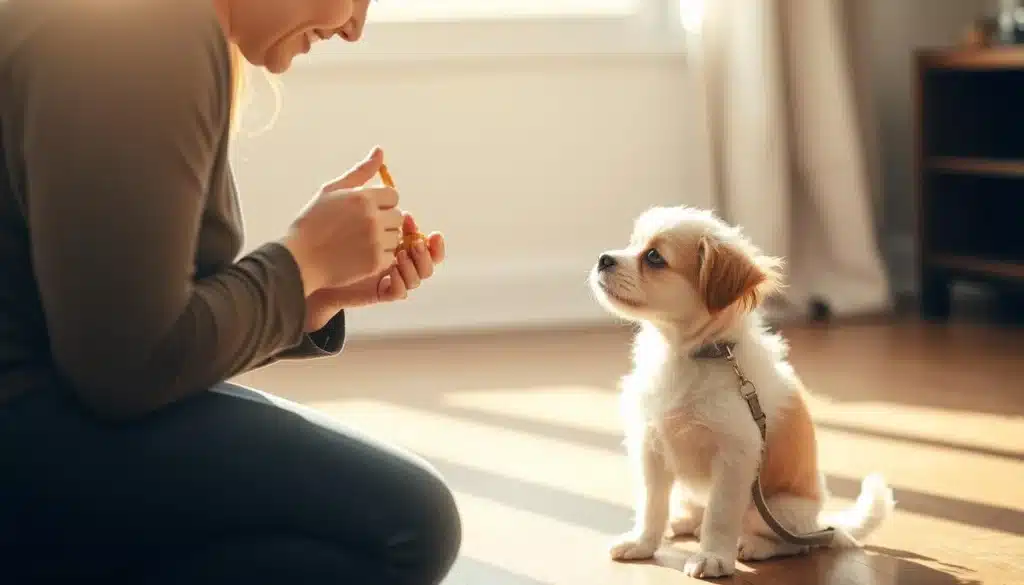
I teach a new action that stops jumping. Sit or relax down are good choices. Tell your dog what to do, not just what not to do.
Cue the word, give a treat, and practice often in short sessions.
Four on the floor rule — set the greeting rule
I make a rule: attention only when all four paws are on the floor. This rule applies during greetings, play, and when coming home. Keeping it consistent helps your dog learn faster.
Immediate reward timing for correct behavior
I reward your dog the moment they stop jumping. This tells them which action is right. AKC-style training supports quick praise and treats.
Don't grab or push your dog. It can feel like play. Remove attention when they jump and give it back when they're calm.
Teaching sit for greetings using positive reinforcement
I have a simple plan to teach dogs to greet calmly. This method is part of basic obedience training and helps dogs learn not to jump. I keep the training sessions short and fun to keep the dog's attention.
First, I use the tethered sit method. I attach a leash to a stable object like a doorknob. Then, I stand a few steps away and ask the dog to sit. I only move forward if the dog stays seated.
If the dog gets up, I go back to the start and ask again. This repetition helps the dog learn that sitting means they get a greeting.
Next, I make the challenge a bit harder. I add distractions and more excitement. For example, I might have a friend say hello loudly or practice near a ringing doorbell. Each time the dog sits well, it gets a reward through positive reinforcement.
When using treats, I gradually reduce them. At first, I reward often to shape the behavior. Then, I use less food and more praise and petting. The American Kennel Club suggests using fewer treats over time. Food helps the dog learn, while praise keeps the behavior going.
Safety and pacing are key. I keep the greetings calm when the dog is learning. This helps the dog develop impulse control. Short sessions also prevent frustration and keep the training positive. This step-by-step approach supports obedience training without using force.
| Step | What I do | Goal |
|---|---|---|
| 1 — Tethered start | Attach leash to a secure point, ask for sit from distance, move in only while seated | Teach the link between sitting and receiving a greeting |
| 2 — Reinforce reliably | Reward every correct sit with a treat plus praise, repeat short trials | Build strong initial behavior using positive reinforcement training |
| 3 — Add distractions | Increase excitement, change people, add noises and gentle movement | Generalize sit across contexts to stop jumping |
| 4 — Fade treats | Reduce treat frequency, keep immediate praise and petting | Shift to attention-only rewards while maintaining reliability |
| 5 — Practice maintenance | Short, frequent refreshers; involve household members | Ensure consistent obedience training for dogs in daily life |
Training the four on the floor method with treats
I use a simple routine to teach four paws on the floor. Start with the dog on a leash. One person gives treats, while another approaches. Toss treats on the ground to keep the dog's nose down and paws on the floor.
While the dog eats, the greeter pets and speaks softly. Then, pick up the dog and repeat the sequence.

Treat-on-floor technique for preventing jumps
The treat-on-floor technique teaches the dog a clear choice. I have the feeder toss treats so the dog looks down before the person reaches. This keeps the dog focused and rewards the right behavior.
If the dog lunges or lifts a paw, I stop treats and the greeter steps back. This shows the dog that calm behavior gets attention.
Timing and repetition for reliable results
Timing is key. I give treats before the dog jumps, not after. Quick, consistent repetitions teach the dog fast: four paws on the floor means treats and petting; jumping means no reward.
If the dog jumps, the greeter turns away until the dog resets. I recommend short sessions throughout the day. One handler tosses treats while another greets the dog. This keeps the timing tight and helps the dog learn faster.
Transitioning from treats to attention-only rewards
I gradually phase out treats so the greeting itself becomes rewarding. First, I extend the greeter's stay while still offering treats. Then, I reduce treat frequency but keep praise and petting immediate.
In time, attention and petting replace treats as the main reward.
| Phase | What I do | Goal |
|---|---|---|
| 1 — Foundation | Frequent tosses on floor, short greeted intervals, leash control | Teach nose-down, paws-down habit |
| 2 — Proofing | Longer greets, treats every other successful greet, varied helpers | Generalize calm greetings with different people |
| 3 — Fading | Fewer treats, immediate praise and petting for correct behavior | Make attention the main reinforcer |
| 4 — Maintenance | Occasional treats for checks, consistent household rules | Keep stop dog jumping behavior reliable long term |
Management strategies to prevent practice of jumping
I keep control by changing the setting so my dog cannot rehearse bad habits. Thoughtful management gives me time to teach calm greetings without confusing cues. Below I cover practical tools, guest prep, and arrival habits that cut down practice and speed learning.
I use basic barriers when guests arrive. Leashing to stop jumping works great at the door. A short leash lets me keep the dog close and reward calm. Baby gates and crates offer a simple physical boundary until greetings are calm. Teaching a reliable “place” cue for a mat or bed gives me a clear option to send the dog away from the doorway until I signal permission.
I prepare visitors before they step inside. I ask family and friends to ignore the dog until I say otherwise and to request a sit before petting. The American Kennel Club and many trainers recommend asking guests to hand out treats only when the dog is seated. That teamwork reduces mixed signals and helps with controlling dog jumping during the learning phase.
On arrivals I keep things low-key to lower excitement. I avoid high-pitched voices and fast movements when I come home. Quiet entries remove emotional triggers that spark jumping. Over time I raise my energy gradually once the dog shows reliable control.
When we walk, I avoid letting strangers approach until rules are solid. I use a “watch me” cue or a toy to redirect attention when people pass by. This prevents public practice of the behavior and supports management strategies to prevent jumping in varied settings.
| Tool | When to use | Benefit |
|---|---|---|
| Short leash | Guest arrivals, doorways | Immediate physical control; supports leashing to stop jumping |
| Baby gate | Open-plan homes, entry areas | Prevents practice, creates safe zone for training |
| Crate or pen | High-traffic times or when I cannot supervise | Removes rehearsal opportunities and calms the dog |
| "Place" cue (mat) | Training sessions, greetings | Gives a verbal/physical target to send the dog away from people |
| Guest instructions | Before visitors arrive | Aligns household and visitors on controlling dog jumping |
How to respond when your dog does jump: do's and don'ts
I always remember to stop rewarding my dog when they jump. This simple change helps them understand what's expected. If your dog jumps, the first thing to do is ignore them. Turn your back, cross your arms, or step back calmly until they put all four paws on the ground.

What not to do
Never push, shove, or hit your dog for jumping. The American Kennel Club advises against using harsh physical corrections. Using force can confuse your dog, making them think it's play or causing fear. It can also damage your bond and make training harder.
What to do instead
Ignore the jump to stop rewarding it. I turn my back, step away, or leave the room. When they sit or stand quietly, I praise them calmly or give a treat. This teaches them that calm behavior gets attention.
I use several training methods to stop jumping. I teach them to sit before greeting, reward them for standing on all fours, and practice calm exercises. Keeping rewards consistent and immediate helps them connect good behavior with rewards.
Consistency across family members
Having different rules at home can slow progress. I ask everyone to follow the same rules when greeting my dog. If one person pets them while they're jumping, it sends mixed signals. For homes where jumping is sometimes allowed, I teach a specific cue like "Up" to ask permission.
| Action | Why it works | How I apply it |
|---|---|---|
| Ignore the jump | Removes attention reward | Turn away until paws on floor, then reward |
| Avoid physical correction | Prevents fear and misinterpretation | No pushing, no kneeing, no shoving |
| Reward alternate behavior | Teaches what to do instead | Request sit, treat or praise when calm |
| Household consistency | Speeds reliable learning | Set one greeting rule for all family and guests |
| Conditional permission | Allows controlled jumping | Use a clear "Up" cue so jumping is earned |
Training strangers, guests, and public greetings
I teach dogs to greet politely by training the people around them as much as the dogs. Clear instructions for guests and passersby make practice simple and consistent. This reduces confusion and speeds reliable results when training strangers to stop dog jumping in homes and public spaces.
First, recruit helpers who will follow a script. Ask friends, neighbors, or willing strangers to request a sit before petting. Offer a small treat for handing over after the dog remains calm. People enjoy being part of the training when they know the steps.
I carry kibble or soft treats on walks to support quick wins. When someone asks to meet my dog, I tell them to wait for a sit. That way I can practice training strangers to stop dog jumping and reward the correct behavior immediately.
On sidewalks I use leash control and distance to reduce the chance to practice jumping. If a passerby approaches, I ask them to ignore the dog and walk past. I may use a “watch me” cue, a squeaky toy, or a treat to refocus my dog so the stranger can pass without interaction.
Until the dog is steady, I avoid unsupervised greetings. This is a key element of managing walk greetings and protecting progress. Tight leash handling and stepping aside keep space between my dog and strangers.
If my household allows jumping for one person, I teach an explicit cue so guests do not accidentally reward it. I use a clear Up command for jumping that means permission to jump when given. I pair it with a visible signal from the permitted person and always follow with an “Enough” or “Off” cue to stop invited jumping.
Teaching the Up command for jumping prevents mixed messages. Guests get specific directions: only pet after a sit, or only respond to Up when the invited person signals. That preserves consistency across different people.
| Situation | Action I take | Goal |
|---|---|---|
| Friend visits at home | Ask them to request a sit, reward after calm | Reinforce polite greetings indoors |
| Sidewalk passersby | Use distance, “watch me,” and ask them to ignore | Manage walk greetings safely |
| Household allows occasional jumping | Teach Up command plus “Enough” to stop | Prevent accidental reinforcement |
| Unreliable public behavior | Avoid unsupervised greetings; practice with helpers | Generalize polite behavior across settings |
Setting your dog up for success with practice and timing
I kept training sessions short and steady when I taught my Labrador to keep all four paws on the floor. Short, focused practice builds habits faster than long marathons. I used simple cues, low distractions, and clear timing so my dog learned what earned attention.
I did multiple two- to five-minute reps throughout the day. That pacing matched my dog's attention span and let me reward correct sits quickly. I started at home, then moved to the porch, driveway, and sidewalk as the behavior held. Accurate practice and timing dog training gave me predictable gains.
Proofing the behavior across contexts and people
I practiced with family, friends, the mail carrier, and a neighbor so the rule stuck with different people and clothing. I raised difficulty slowly by adding excitement, dogs walking nearby, or toys in view. Consistent proofing behaviors meant my dog greeted reliably at the front door, on walks, and at the park.
When to seek professional help
If jumping keeps happening despite steady work, I suggest contacting a certified positive-reinforcement trainer or behaviorist. The AKC GoodDog! Helpline and qualified trainers can offer tailored coaching by phone or video. Seek help sooner for large or reactive dogs, since safety risks change the priorities around when to seek dog trainer.
I tracked incidents by noting time, location, and who was present. That log made it easier to tweak practice sessions and gave a new trainer useful detail if I needed outside support.
Common pitfalls and troubleshooting
Many owners hit roadblocks with small mistakes. This guide helps you find and fix these issues. It's all about getting back on track to stop your dog from jumping.
Inconsistent reinforcement is a major hurdle. If some family members let the dog jump while others don't, it confuses the dog. Choose one rule and teach everyone to follow it. Practice this rule at every door and after walks.
Role-play drills can help if your family has trouble agreeing. Have everyone practice arriving and rewarding the dog correctly. Do this until the dog knows how to greet each person right.
Yelling, pushing, or grabbing can make things worse. These actions give the dog attention and might seem like play. Instead, use planned ignoring. Step away, cross your arms, and wait for the dog to calm down before giving attention. Reward them quickly to show calm behavior is good.
High-energy or large-breed dogs need special care. They need more exercise and play to calm down before training. This helps them focus better during lessons.
Using management tools is key when safety is a concern. Use a leash, baby gate, or "place" cue during training. Break lessons into small steps and raise the bar slowly. Short, frequent sessions with treats work well for big dogs.
If your dog only jumps for certain people or situations, focus on that. Increase rewards during tough drills and make tasks simpler if needed. Troubleshooting stop dog jumping often means focusing and proving the cue in hard situations.
If you're not making progress, make a checklist. Check if your household has a clear rule, everyone is practicing the same, and you're using management tools for safety. Also, make sure your dog is getting enough exercise and use short, rewarding training sessions. These steps can help overcome common problems and bring back consistent success.
Conclusion
I've noticed a big change when owners teach their dogs a new trick. Like a solid sit or the "four on the floor" rule. Using treats right away and keeping arrivals calm helps a lot.
It's also important to keep training sessions short and regular. This way, the dog remembers what they learned.
Setting up barriers like gates and using leashes helps too. Clear rules in the house stop dogs from practicing bad habits. Asking guests to make the dog sit helps too.
As training goes on, start using praise more and treats less. This way, the dog learns to follow commands without needing food all the time.
If you're not seeing progress or worry about safety, get help. A certified trainer or the AKC GoodDog! Helpline can offer personalized advice.
For me, the next step is to establish a clear greeting rule. Use treats immediately and make sure everyone agrees. With consistent effort, these tips can make greetings much better.