I remember the first time my terrier ran wild after a short walk. My living room was a mess, and I felt frustrated. I learned to calm my hyper dog by meeting their needs: more exercise, mental games, and regular routines.
Experts say most dogs aren't truly hyper. Karen Overall says most high-energy behavior is due to unmet needs. Following AKC advice, owners see improvements with a plan that covers physical, mental, and social needs. If this doesn't work, a vet visit is next.
In this article, I'll share a simple, everyday way to calm a hyper dog. You'll learn how to calm a hyperactive dog and even train a puppy. My aim is to help you create routines that turn energy into calm companionship.
Key Takeaways
- Most "hyper" behavior comes from unmet needs, not true hyperactivity.
- Consistent exercise and mental work are the foundation for training a hyper dog to be calm.
- Use a multi-level plan—body, brain, manners, environment, and nutrition—for lasting results.
- Apply predictable routines and breed-appropriate activity to reduce zoomies and destructive behavior.
- When structured approaches fail, consult a veterinarian or certified trainer.
Understanding why dogs seem hyper
Many people wonder why dogs seem so energetic one minute and calm the next. I look for patterns to understand this. Most dogs are not truly hyperactive. Instead, they have high energy or unmet needs.
I start by checking the dog's home routine, exercise, and diet. When owners learn to calm their hyper dogs, they often find simple solutions. More purposeful activities, mental challenges, or clear rules help a lot.
Distinguishing true hyperactivity from high energy
True hyperactivity is rare. It means a dog reacts too much to sounds, can't relax in familiar places, and has a very short attention span. I look at breathing and heart rate to see if it's true hyperactivity.
Most dogs are just very energetic. They need to run, play, and chew. Teaching owners how to calm their dogs starts with the right exercise and mental tasks.
Common causes: breed, age, environment, and health
Breed traits play a big role. Dogs like Border Collies and Siberian Huskies were bred to work all the time. Young dogs and terriers also tend to have more energy. A short walk might not be enough for a Border Collie.
Environment and schedule also affect behavior. Dogs left alone with little to do can get frantic or destructive. I help owners manage their dog's energy by matching activities to their breed and age.
Medical issues can also cause hyper behavior. Problems like thyroid issues or neurologic changes can make dogs act differently. If behavior changes suddenly or calming strategies don't work, it's time to see a vet.
I also talk about reactive behavior. Dogs that overreact to people or other dogs need special training. I teach owners how to calm their reactive dogs using distance, gradual exposure, and clear rewards.
how to train a hyper dog to calm down
Dealing with a high-energy dog can be overwhelming. Before starting intense training, set realistic goals based on your dog's breed, age, and personality. Some dogs, like Border Collies and Labrador Retrievers, need more physical and mental challenges than others.
First, assess your dog's daily needs. Consider how much exercise they get, the variety of activities they enjoy, and any health issues. I recommend a checklist to track walks, playtime, puzzle-solving, naps, and vet visits. This helps plan routines that reduce excitement and unpredictability.
Set realistic expectations and evaluate daily needs
Divide the day into clear segments: morning exercise, midday activities, afternoon training, and evening calm-down. Short, consistent sessions are better than long, irregular ones. Use high-value treats and small steps to encourage calm behavior.
Keep track of changes each week. If your dog still runs wild, add more mental games before increasing physical activity. A tired brain often leads to a calmer body.
Multi-level approach overview
I use a multi-level plan focusing on body, brain, manners, diet, and health. Exercise burns off excess energy. Mental games give purpose. Obedience helps control impulses. Diet and vet checks check for health issues causing hyperactivity.
Here's a quick comparison to help plan. I've included sample actions, expected results, and quick timing for a busy schedule.
| Focus | Sample Actions | Expected Effect | Time per Day |
|---|---|---|---|
| Body | Walks, fetch, agility, long play sessions | Reduces excess energy, improves sleep | 30–90 minutes |
| Brain | Nose work, food puzzles, short training drills | Provides mental fatigue, focuses attention | 10–30 minutes |
| Manners | Impulse-control games, sit-stay, leave-it | Better self-control, fewer attention-seeking bursts | 5–15 minutes |
| Diet & Health | Quality food, vet checkups, consider supplements | Stabilizes energy, rules out medical causes | Ongoing |
| Routine | Set meal, walk, play, nap, and training times | Reduces unpredictability, lowers arousal | Structured daily |
Use dog training for hyper dogs as a clear phrase in your plan. It reminds you of the specific techniques for active breeds. Keep a flexible attitude. Small, steady wins add up fast when you apply strategies for calming a hyper dog.
To find effective ways to relax a hyperactive dog, mix activities. This gives your dog physical outlets and mental challenges. I suggest testing changes over two-week blocks to see what truly helps.
When wondering how to train a hyper dog to calm down, remember patience and a layered plan are key. Stick with consistent routines and adapt based on your dog's response.
Work the body: exercise plans for hyper dogs
I start by comparing what your dog does daily with what their breed needs. Breeds like border collies and Labrador retrievers need more than just a walk. To calm a hyper dog, first, track their activity and set clear exercise goals.
How much and what kind of exercise different breeds need
Terriers and spaniels do well with short, frequent sessions. Sporting and herding dogs need longer, structured outings. For active breeds, a single short walk is not enough. I suggest matching breed tendencies with exercise types and increasing intensity as needed.
High-energy activities that burn excess energy
Games like fetch, tug, and flying disc add rules and training cues. Swimming and water play are great for a strong workout with low joint stress. Agility, lure coursing, and dog sports channel drive into focused tasks, reducing manic behavior. These activities help manage hyper activity in dogs.
Building a consistent daily activity schedule
I use a sample routine that mixes aerobic and high-intensity work. Try three 15–20 minute walks, a longer run or swim, and two focused play or training sessions. Add quiet time after activity to reinforce calm.
I track duration and intensity each week. If your dog is still hyper, increase aerobic work or add more short, supervised off-leash runs. Tools like fenced yard games, an automatic ball launcher, or doggy daycare can help when I'm not there.
When owners ask how to calm a hyperactive dog, I say consistency is key. A clear plan, varied activities, and steady tracking can lower hyper behavior. This makes managing hyper activity in dogs possible for busy households.
Work the brain: mental stimulation and calming exercises for hyper dogs
I start with short brain games that exhaust the mind before the body. These activities help a hyper dog relax and improve focus. I mix up quick scent games, puzzle feeders, and short training sessions to keep things interesting.
Nose work and scent games
Nose work gives dogs a job. I hide treats and say “find it.” This makes them focus on scent and slow down. Dogs who love sniffing tend to calm down after playing.
Food-dispensing puzzles and enrichment toys
Food-dispensing puzzles make meals fun. I suggest toys that release kibble slowly. They keep dogs busy and teach them to solve problems. Start with easy puzzles and make them harder as they get better.
Training games and clicker shaping
Clicker shaping teaches dogs in small steps. I reward them for small achievements, making them think. Short sessions of 5–10 minutes help them focus. Use settle cues after training to reinforce calm behavior.
- Rotate scent work, puzzle feeders, and shaping to avoid boredom.
- Keep sessions brief and predictable; that helps with how to train a puppy to calm down.
- Use these methods as part of your broader dog training for hyper dogs plan.
Consistent mental exercises and a clear routine lead to steady progress. Using these calming exercises for hyper dogs changes the household's energy. Small daily habits add up to big results over time.
Instill manners and impulse control through basic obedience
I teach dogs to be polite instead of pushy. This means no more jumping, nose-bopping, or barking for food. Before I open doors, hand out toys, clip the leash, or set down a bowl, I ask for a sit or down.
It's important that everyone in the house does the same thing. This way, the dog learns that politeness is always expected.
Short training sessions are better than long ones. I use treats and praise to reward calm behavior. Then, I slowly increase the time the dog must stay in the sit or down position.
This method helps dogs learn to stay calm and teaches owners how to train them effectively.
Essential commands to manage hyper behavior
I focus on a few key commands: sit, down, stay, and leave it. These are important skills that help manage a dog's excitement. A good down-stay is especially useful when guests come over or when the dog needs to stay calm at the door.
I practice these cues in short sessions, using real-life situations. For example, I ask for a sit before opening the door and reward the dog for calm behavior. This makes training more effective and teaches the dog to control impulses.
Teaching “please” behaviors and delaying rewards
I teach dogs to ask politely before getting something. If they try to grab food, I ask for a sit or down first. Only after they are calm do I give them the food.
To make them stay longer, I start with short waits and gradually increase them. I keep the training positive, which helps calm hyperactive dogs without punishment.
| Skill | Purpose | Practice Tip |
|---|---|---|
| Sit | Stops jumping and gains immediate control | Ask for sit before greetings; reward first calm response |
| Down | Promotes long-form calm and reduces roaming | Use a mat; practice down-stays at the door and during feeding |
| Stay | Teaches how to train a dog to stay in place despite distractions | Start short, add distance and duration, use release word |
| Leave It | Prevents grabbing forbidden items and reduces impulse actions | Practice with treats on the floor, reward for looking away |
| Polite Request | Replaces demanding behaviors with asking nicely | Require a polite cue before access to toys, doors, or food |
Reward calm behavior and ignore attention-seeking hyperactivity
I focus on making calm the most rewarding option for my dog. When I catch a quiet moment, I give soft praise or a gentle pat. This teaches the dog that relaxation is positive.
I avoid interacting only when my dog is being naughty. This can teach them to seek attention in bad ways instead of learning self-control.
I use high-value treats after exercise and mental work to mark calm. This teaches my dog that being relaxed leads to rewards. I track short sessions where calm is consistently reinforced.
I teach simple “please” behaviors like sit or place before giving anything. Requiring calm before release makes self-control a gateway to desired outcomes. These cues become tools I use daily to shape quiet habits.
How to reinforce calm without accidentally rewarding bad behavior
I never reward jumping or barking for attention. I wait until four paws are on the floor and the dog is still before delivering rewards. If the dog tries to grab attention, I look away and ignore until calm returns.
I keep rewards predictable and timely. Treats come the moment calm appears, not a minute later. This immediacy helps my dog associate relaxed posture with good things.
Practical exercises to shape calm moments
- Settle sessions: After a walk, cue “place,” give a puzzle toy, and only release when the dog rests for a short target time.
- Incremental calm holds: Reward 5 seconds of quiet, then 10, then 20. Build duration slowly to reinforce longer calm periods.
- Ignore-and-reward drill: Ignore attention-seeking jumps, then reward the instant the dog sits or lies down with a soft treat.
- Calm-before-play routine: Require a sit or down for three breaths before tossing a ball. This establishes calm as the path to fun.
| Exercise | Goal | How I reward calm |
|---|---|---|
| Short settle sessions | Teach immediate calm after activity | Low-value kibble or praise when dog stays on place cue for 10–30 sec |
| Incremental holds | Increase calm duration | Small treats at each increased time milestone, then release |
| Ignore-and-reward drill | Reduce attention-seeking hyperactivity | Turn away during demand, reward when four paws are on floor |
| Calm-before-play routine | Make calm the cue for reward | Immediate play or toy after a calm sit or down |
These approaches combine reward calm behavior with clear boundaries. I mix them with techniques to help a hyper dog relax during transitions and rest periods. Over time, ways to relax a hyperactive dog become part of daily life, and tips for calming a hyperactive dog stay practical and repeatable.
Nutrition and supplements that may affect energy and behavior
I look into how food and supplements can change a dog's energy and mood. Bad diets with fillers and artificial colors can make dogs too energetic. I suggest a high-quality diet with real meats to keep energy steady.
I use simple treats during training. Chews like beef marrow bones and small treats keep dogs focused. This helps avoid making hyper behavior worse.
Here are safe supplement options and steps to add them to your dog's routine.
How diet quality influences activity levels
Quality food is key for steady energy. Foods with whole proteins and balanced fats help. I choose foods with clear ingredients and no byproducts to avoid restlessness.
Safe supplements and when to consult a vet
Some supplements can help with training and exercise. Omega-3 fatty acids support brain health. Calming blends can help dogs relax during stressful times.
I always use supplements with a behavior plan and exercise. Before starting calming supplements, I talk to my vet about dosage and quality.
If hyperactivity doesn't improve with diet and exercise, I seek vet advice. Medical issues like thyroid problems can cause high activity. I discuss when to consult a vet to rule out underlying causes.
Management strategies for the home and when indoors
I keep my dog's routine simple to help them calm down. A daily schedule with set times for walks, play, meals, and naps helps. This structure reduces overstimulation and gives my dog clear expectations.
I also train my dog to use short "please" routines at doors and mealtimes. This builds impulse control and makes the house feel calmer.
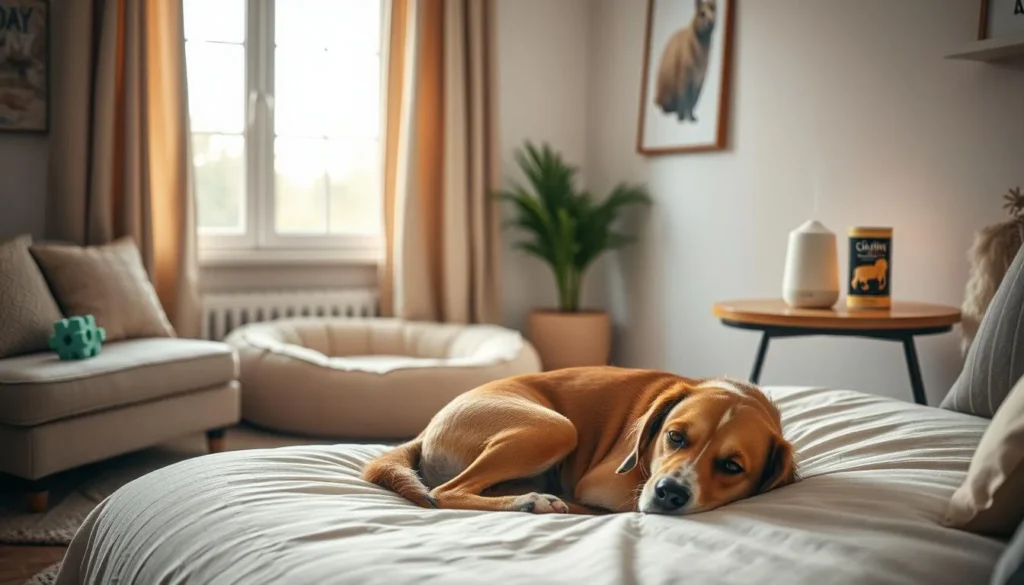
Setting up a calm environment and predictable routine
I create quiet zones with a crate or a designated place bed for my dog to rest. I use low lighting and soft music during these times. When we can't go outside, I shorten active sessions and play indoor games to keep energy balanced.
I follow a daily checklist: morning walk, midday play or puzzle, training session, and evening calm time. This helps me manage my dog's energy without relying on one-off solutions.
Tools and toys that help calm a hyper dog in the house
I use reward-based training gear like a clicker, a flat buckle collar from Blue-9, and a treat pouch. Puzzle feeders, KONGs stuffed with kibble and peanut butter, and marrow-style chew toys keep my dog busy. I also use a calming mat and a firm crate to teach my dog to choose rest.
For long absences, I use interactive toys and automatic ball launchers. Doggy daycare and supervised play sessions reduce pent-up energy and teach social manners. These strategies work best when combined with consistent training.
| Problem | Tool or Strategy | When to Use |
|---|---|---|
| Excess morning energy | Short brisk walk + 10-minute training session with clicker | Each morning before breakfast |
| Storm anxiety or guests | Crate with chew-safe marrow bone and calming mat | During loud events or visitor arrival |
| Long owner absence | Interactive treat-dispensing toy + automated ball launcher | Workdays or long errands |
| Limited outdoor access | Hide-and-seek scent games and food puzzles | Rainy or extreme weather days |
| Impulse control at doors | “Please” routine and consistent reinforcement | Every exit and entry |
Handling reactive or medical cases: when to get professional help
I work with many owners who try exercise and enrichment first. But sometimes, the dog still can't settle. At that point, I recommend a clear plan.
Document what you see, note timing, triggers, diet, and daily routines. This record helps a veterinarian or trainer make faster, smarter decisions.
Medical screening is next when physical signs or sudden changes appear. Signs that suggest a veterinary evaluation include rapid breathing, persistently high heart rate, weight loss, tremors, or a dog that cannot relax in places it used to find restful. Metabolic disease, liver dysfunction, hyperthyroidism, and neurological issues can all show up as excess activity.
If you wonder when to see a vet for hyperactivity, err on the side of evaluation. Early tests can rule out or catch treatable conditions.
Signs that suggest a veterinary evaluation
Watch for physical symptoms that accompany frantic behavior. Note any collapse, disorientation, poor appetite, or new pain signs. If behavior changes suddenly after a vaccine, medication, or injury, mention that to your veterinarian.
Bring your log of exercise, feeding times, supplements, and exact trigger events. I find that a concise timeline often reveals patterns and narrows diagnostic options. Bloodwork, thyroid panels, and neurological exams are common next steps when vets assess hyperactivity.
When to work with a certified trainer or behaviorist
When medical issues are cleared or when structured training has failed, I recommend consulting a certified dog trainer for hyper dogs or a behaviorist for reactive dogs. Look for credentials such as CPDT-KA for trainers and diplomate status from the American College of Veterinary Behaviorists for complex cases. These professionals bring applied learning plans and evidence-based behavior modification.
If your dog reacts aggressively or panics around people, animals, or specific environments, a tailored plan can teach coping skills and safety strategies. I advise starting with a trainer or behaviorist who will collaborate with your vet when needed. That team approach speeds progress and reduces relapse.
- Document behavior daily before the appointment.
- Share videos of reactive episodes to give professionals clear examples.
- Ask about stepwise behavior modification and measurable goals.
I guide owners to seek help when basic changes do not yield steady calm. Learning how to train a reactive dog to calm down takes time, precise steps, and the right expertise. Pairing veterinary checks with a certified dog trainer for hyper dogs or a behaviorist for reactive dogs gives the best chance for lasting change.
Practical training session plan and progress tracking
I use short, frequent sessions that mix physical work with mental tasks to build focus. Five to ten minute blocks of shaping or clicker training fit into a busy day. They help train a hyper dog to be calm.
Here is a simple daily template I follow. Morning starts with a brisk walk or run, followed by a 5–10 minute obedience drill. Midday I add a puzzle feeder or scent game. Evening includes a play session plus a settle practice to reward calm behavior.
Short-session templates for busy owners work best when consistent. I keep treats small and high-value for focused work. I split tasks so the dog gets physical exertion, cognitive challenge, and explicit calm-reward moments.
Short-session checklist:
- 5–10 minute morning training: sits, stays, recall shaping
- Midday enrichment: puzzle feeder or nose work
- Evening: play, then a 5-minute settle routine
How to measure progress training a hyper dog starts with a simple log. I note date, activities completed, and behavior outcomes. I track unwanted behaviors like zoomies or chewing and note ability to hold a stay or settle on cue.
I use a small table to compare weekly results and spot trends. If restlessness stays high, I increase exercise or add enrichment. If no change after consistent effort, I consult a vet or certified trainer.
| Date | Activities | Unwanted Behaviors Observed | Calm Response (rating 1–5) |
|---|---|---|---|
| Aug 1 | 20 min run, 2x 7-min training, puzzle toy | One zoomie session, mild mouthing | 3 |
| Aug 8 | 30 min walk, 3x 5-min shaping, scent game | No destructive chewing, brief zoomies | 4 |
| Aug 15 | 25 min run, 2x 10-min focus drills, feeding puzzle | Rare restlessness before bed | 4 |
Use the log to adjust a practical session plan to calm a hyper dog. Increase physical exertion if the dog still shows excess energy. Add more nose work or puzzle time if boredom seems to drive the behavior.
Tracking helps answer the core question of training a hyper dog to be calm. Small, measurable gains add up. I review notes weekly and tweak the plan until the routine produces steady calm at predictable times.
Conclusion
Most cases of hyperactivity in dogs aren't about a bad dog. It's often about a mismatched routine. To calm a hyper dog, mix physical activities, mental challenges, and manners training.
A body-and-brain approach works best. This includes breed-appropriate exercise, scent work, and puzzle toys. Also, use consistent obedience cues and a predictable daily routine. This method changes behavior more than punishment.
Create a simple plan to calm your hyper dog. First, consider your dog's age and breed needs. Then, set an exercise schedule and add calming activities like nose work and food puzzles.
Teach impulse control with short, frequent lessons. Improve your dog's diet and make the indoor environment calm. This reduces triggers for overexcitement. Track your progress and adjust the plan as needed.
If you notice sudden changes or health issues, get a vet or behaviorist's help. With patience and consistency, you can train your hyper dog. This will make your home quieter and happier.