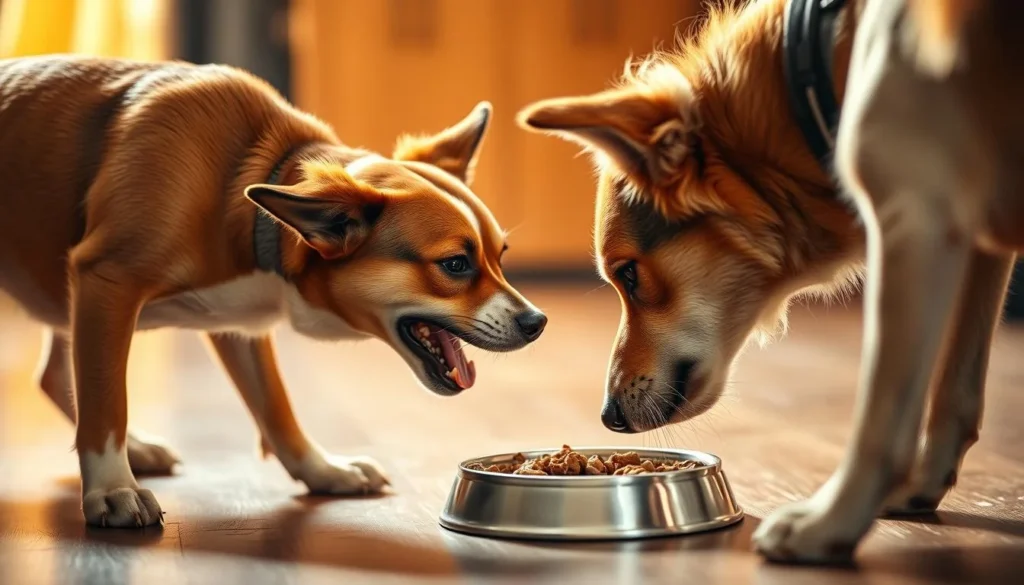
I remember the first time my dogs froze over a shared bowl. One dog curled low with a hard stare, the other backed away with ears flat. My heart raced with worry about bites, vet bills, and if I'd made a mistake.
This fear drove me to learn how to keep my home safe at mealtimes. I used veterinary behavior science and shelter practice to teach my dogs to share. I created a plan of desensitization, counterconditioning, and smart management. This plan helped my family and can help others too.
Key Takeaways
- Food aggression between dogs is a form of resource guarding that ranges from mild warnings to serious bites.
- Immediate safety measures—separate feeding areas and timed meals—reduce risk while you train.
- Effective resource guarding treatment uses desensitization and counterconditioning in staged steps.
- Consistency among all household members is essential for lasting canine food aggression solutions.
- Seek a Certified Applied Animal Behaviorist, a board-certified veterinary behaviorist, or a CPDT if warnings escalate or you feel unsafe.
Understanding food aggression and resource guarding in dogs
I start by defining the problem so readers can spot it early. Food aggression is when a dog defends food or items related to it. This can range from a low growl to a snap or bite. It includes bowls, chews, counters, treats, and anything the dog values.
Next, I clarify the resource guarding definition. It's not just about food; it also includes toys, beds, and even a human's attention. Food aggression is a part of this because the dog sees food as something to protect.
To explain causes of food aggression, I look at evolution, anxiety, and learning. Wild ancestors who protected food had better survival odds. Dogs that lived through scarcity or competition, like shelter dogs, tend to be very alert around meals. Training errors, like taking items away or rewarding growling, can teach a dog to use aggression.
Common triggers are easy to miss in daily life. Bowls on the floor, high-value bones and chews, treats, and food left on counters can spark tension. Group meals or dropped human food can also cause problems. Noticing these triggers helps me suggest practical steps and exercises.
Certain dogs face greater risk. Puppies learn competition behaviors in litters, shelter dogs often carry histories of scarcity, and dogs with trauma may guard out of fear. Some breeds show guarding tendencies more often, though breed alone does not determine behavior. Understanding who is at risk helps me advise families on safe management and training.
Recognizing signs and warning signals before aggression escalates
I keep a close eye on dogs during meals to spot food aggression early. Small changes in posture or mood give me time to act before things get dangerous.
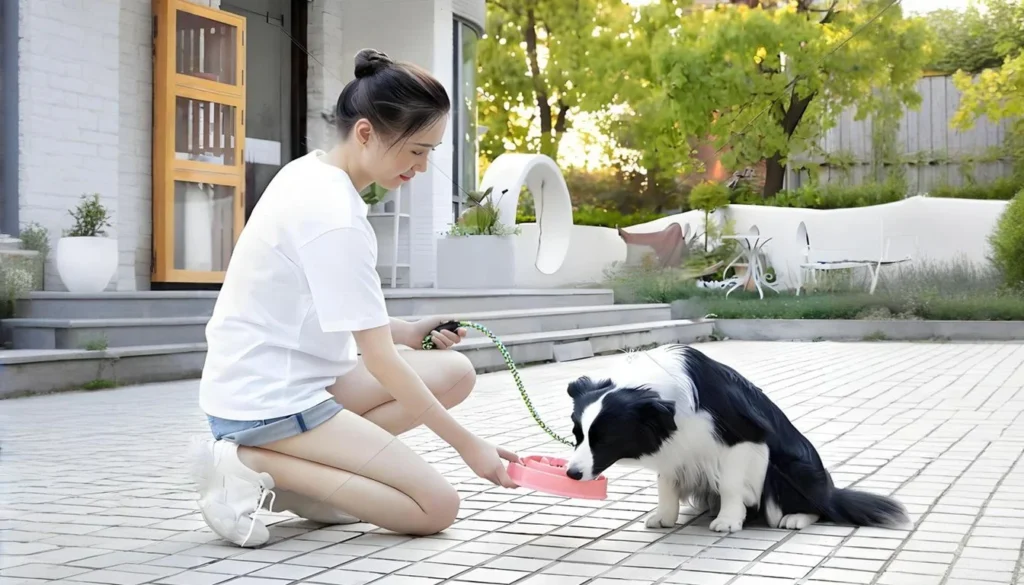
I watch for stiffness, a fixed stare, and raised hackles in body language. A dog that freezes or stares intensely while guarding food is stressed. Signs like lip pursing, subtle lip-licking, and sudden withdrawal often signal trouble.
Vocal and facial cues are clear warnings. Low growls, snarling, and showing teeth mean the dog feels threatened. Air snaps and forward lunges are immediate safety risks. If I hear a growl, I stop and back off instead of trying to comfort the dog.
Knowing the severity of aggression helps me decide how to act. Mild signs include growling, brief stiffening, and lip lifts. These can be managed with careful desensitization, but caution is key.
Mild vs. severe resource guarding affects my approach. Moderate cases show snapping, lunging, and intense staring. I use management tools and staged training with professional help if it's risky.
Severe guarding, like biting or chasing, is dangerous. If I see these signs, I call a veterinary behaviorist or a certified behavior professional for help.
| Warning Tier | Typical Signals | Immediate Action |
|---|---|---|
| Low / Mild | Stiffening, lip lift, low growl, fixed stare | Increase distance, note triggers, begin gentle desensitization |
| Moderate | Snapping, lunging, sustained intense stare, air snaps | Use barriers or separation, pause training, consult trainer |
| High / Severe | Biting, chasing, aggressive charging, forced displacement | Secure by tethering or gating, seek veterinary behaviorist or CPDT-AI specialist |
Assessing risk, I avoid close contact if unsure. Safety is always first. If I need to work on food aggression, I start with distance-based exercises and follow professional advice.
Safety first: managing risk at home during training
I always start by reducing immediate risks. Before training, I create safe, controlled spaces. This ensures no one gets hurt and dogs feel safe.
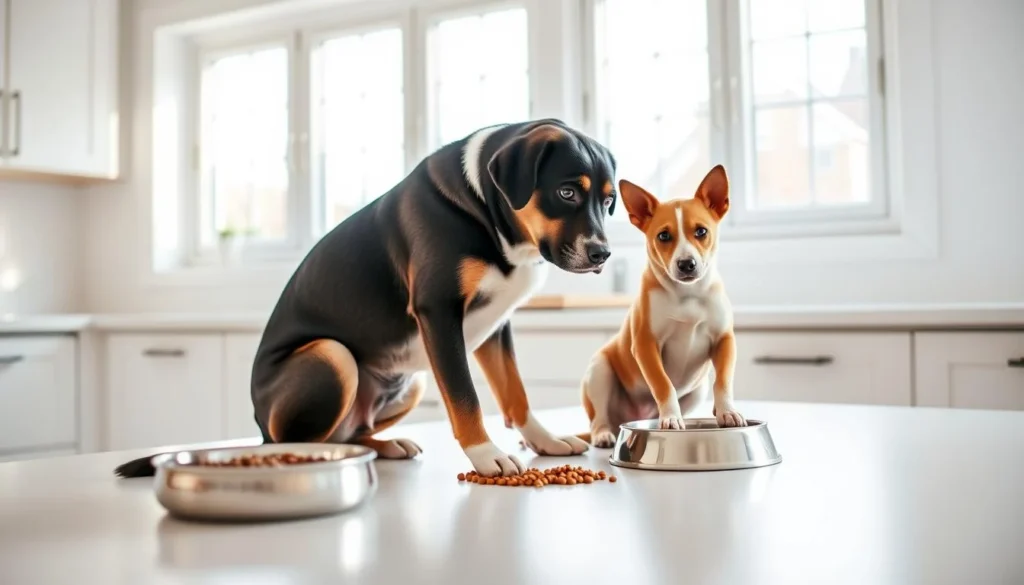
I use simple barriers and routines. I set up separate feeding areas in different rooms or behind baby gates. Crates or short tethers let one dog eat while the other is out of sight. Timed meals replace free-feeding so I control when food appears.
I add tools that slow eating and reduce conflict. Slow-feeder bowls and puzzle feeders keep dogs busy. Elevated stations work for some dogs. I remove high-value items when I’m not supervising to avoid surprise escalations.
I handle multi-dog mealtimes with clear roles. Each dog gets a dedicated bowl and spot. I stagger feeding times or use opaque barriers so they can’t stare at one another’s food. I reward calm behavior like sit or wait before I set bowls down.
Human safety is nonnegotiable. I never ask children under 18 to run exercises with a guarding dog. If a dog has bitten or snaps, I stop close-contact training and seek a certified professional with aggression experience, such as a CPDT or a veterinary behaviorist.
I watch for signs that DIY must stop. If a dog escalates during low-intensity drills, refuses to eat, or shows intense stress, I pause and consult a behaviorist or my veterinarian. A vet visit rules out pain as a cause and helps me decide next steps.
These management steps give me time to train without risking safety. When I pair them with a behavior plan, I can focus on how to fix food aggression between dogs safely while keeping everyone protected.
How to fix food aggression between dogs
I want to share a simple, step-by-step guide to reduce mealtime tension. The main idea is to use gradual exposure and positive pairing. This way, your dogs will learn that people near them mean good things, not harm.
Principles: desensitization counterconditioning explained
Desensitization counterconditioning helps change a dog’s feelings. Start by standing far away where the dog feels calm. Throw a treat while you're a few feet off. Keep doing this until the dog eats without stress.
Then, take a small step closer and repeat the process. This helps the dog get used to your presence without feeling scared.
Stepwise training overview adapted for multi-dog households
- Stage 1: Individual baseline. Work with one dog at a time in a quiet room. I stand well back and toss treats while they eat.
- Stage 2: Close approach. When the dog eats calmly for about 10 meals at a distance, I move nearer and keep offering treats.
- Stage 3: Hand-treats and touch. Next I offer food from my hand, then gently touch the bowl after the dog remains calm for multiple meals.
- Stage 4: Lift and handle. Only after repeated calm responses do I pick up or lift the bowl briefly, always following with a very tasty reward.
- Stage 5: Generalize. After each dog masters the steps alone, I run parallel sessions where dogs are separated by barriers and then gradually reduce separation as long as both stay relaxed.
Multi-dog training plan notes
When training multiple dogs, I start with each dog separately. This prevents competition. I use different handlers or staggered sessions to avoid stress triggers.
Once each dog is calm, I bring them together. They practice side by side with distance and barriers.
Role of consistency and household protocol
It's important for all family members to follow the same steps and cues. Mixed signals can slow progress and cause setbacks. I suggest using a single phrase like “What have you got there?” in a friendly tone.
Everyone should start at each dog’s current stage. Progress only when the dog shows calm eating across roughly 10 meals per stage.
Practical pacing and emotional goals
Move slowly and keep sessions short. My goal is to change anxiety into anticipation. The dog should expect something good when people approach.
If a dog stiffens, growls, or avoids, I back up a stage. I rebuild confidence with easier steps and high-value rewards.
This method offers a clear, humane way to fix food aggression between dogs. It uses evidence-based desensitization counterconditioning in a realistic multi-dog training plan.
Stage-based training exercises adapted from evidence-based protocols
I'll show you a step-by-step plan for training dogs. It builds trust slowly, making them welcome you at mealtime. This method is called staged training for food guarding.
Here are the main steps I follow. Sessions are short, calm, and easy to repeat. I use treats like small chicken or cheese pieces to show the dog that I'm a good thing.
- Stand a few feet away and toss special treats while the dog eats kibble.
- Step one step closer, toss treat, then step back; work toward about two feet.
- Stand next to the bowl, drop treats, then turn and walk away.
- Hand-feed a high-value treat while bending closer each day until my hand is next to the bowl.
- Touch the bowl while offering treats.
- Pick up the bowl briefly (6–12 inches), add a treat, return it; lift higher and move it to a table over time.
- Have all family members repeat stages to generalize the behavior.
I use a friendly script during training: “Enjoy your food” or “What have you got there?” I say it often, in a warm, neutral tone. This keeps the dog focused on the treats and my voice, not on guarding.
Here's a quick checklist for a single session. Each round should last a minute or two. Stop while the dog is still relaxed.
| Step | Action | Session Goal |
|---|---|---|
| 1 | Stand 3–6 feet away and toss treats | Dog accepts tosses while eating kibble |
| 2 | Move to ~2 feet, toss, then retreat | Dog stays calm when I approach |
| 3 | Stand beside bowl, drop treats, walk away | Dog tolerates close presence |
| 4 | Hand-feed high-value treat, bend closer daily | Dog takes food from my hand near bowl |
| 5 | Touch bowl while offering treats | Dog accepts bowl contact |
| 6 | Pick up bowl briefly, add treat, return | Dog tolerates temporary removal |
| 7 | Repeat with family members | Behavior generalizes across people |
For dogs that gulp food or eat too fast, use slow-feeder bowls or split kibble. This makes it easier to give treats and keeps the dog interested.
If a dog won't participate, stop and go back to the last successful step. If they still refuse, it might be stress or pain. In that case, see a vet and a certified behaviorist before continuing.
Remember, bones and high-value chews need special training. Start with short contact and small upgrades. For help with food aggression, use the hand-feed and touch-bowl steps slowly with irresistible treats.
Always prioritize safety. If you see stiffening, lunging, or intense growling, stop and get professional help. Use this script and steps only when the dog shows relaxed, consistent progress.
Specific strategies for common scenarios: dogs with other dogs, cats, humans, bones, and treats
I help owners with practical steps for feeding conflicts. Here are strategies for common problems and simple scripts to try at home. These methods focus on safety, routines, and slow, confident training.
Prevent competition by feeding in separate rooms, crates, or behind baby gates. For joint training, start with large spaces and reward calm behavior from afar. Train each dog separately to build calm responses before parallel sessions.
Use consistent cues like “wait” and reward quiet with a small chew upgrade when both dogs are calm.
How to stop food aggression in dogs towards cats and coexistence tips
Keep cat and dog feeding stations separate. Elevate the cat’s bowls when possible. Never leave them unsupervised during meal prep.
Begin desensitization at a safe distance and pair the cat’s approach with rewards for the dog. Shorten distance only when the dog shows calm body language and soft interest.
How to stop food aggression in dogs towards humans: hand-feeding and trust-building
Start hand-feeding to make your approach valuable. Offer higher-value bites while the dog eats and move toward full hand-feeding sessions. Teach “give” and “leave it” using trades that are always better than what the dog holds.
Keep sessions short, calm, and upbeat. If a dog lunges or stiffens, back up to a safer step and rebuild trust more slowly.
How to stop food aggression in dogs with bones and high-value chews
Pre-emptive management works best for chews: give bones in a separate room or crate when guarding is severe. If you train around chews, use the same staged approach as with bowls but expect a longer timeline.
Teach an ironclad trade cue so you never reach in to take a chew without an exchange. If you must remove a chew, offer a confirmed upgrade and praise the drop.
Treats management and reward-based alternatives
Avoid freely handing out high-value treats unless they are part of a plan. Use the treat-drop method during meals so human approach equals upgrade. Teach a settled alternative like “go-to-mat” and reward that behavior rather than allowing free scavenging.
Consistent treats management reduces surprise value and lowers guarding triggers.
| Scenario | Immediate Management | Training Focus | Timeline |
|---|---|---|---|
| Two dogs at mealtime | Separate rooms or gates; staggered feeding | Parallel desensitization; reward calm at distance | Weeks to months depending on history |
| Dog and cat feeding | Separate stations; elevate cat bowls | Desensitize to cat presence with treats | Several weeks with steady sessions |
| Dog guarding from humans | Confine during risky moments; no reach-ins | Hand-feeding, trade games, “give” cue | Days to weeks for hand-feeding; longer for full trust |
| Bones and chews | Give in crate or remove when unsupervised | Longer staged trades; never force retrieval | Months for strong generalization |
| Treats and rewards | No free high-value treats; scheduled rewards | Treat-drop, go-to-mat, settle behaviors | Days to establish routine; ongoing reinforcement |
Prevention and early-life practices to reduce future guarding
I start early with easy routines that make meals calm and cooperative. Small steps now help prevent resource guarding in puppies and cut the chance of food fights later. These practices fit into daily life and set up a relaxed household culture around food and toys.
I use hand-feeding puppy sessions to build trust. I sit with the pup and offer single kibble pieces while petting and talking softly. Gradually I move to holding the bowl in my lap, then to placing it on the floor while I occasionally drop a tastier treat in.
I teach a simple “treat drop” routine so the pup learns that my approach predicts better food. While the puppy eats, I drop a higher-value bite into the bowl at random. If the puppy shows tension, I pause and go back a step until the pup relaxes.
Equitable resources cut competition. I keep multiple bowls, beds, toys, and treats so scarcity never becomes a trigger. When I bring home a new bed or chew, I introduce a duplicate item for the other dog to avoid jealousy.
I remove or manage items that cause repeated guarding. If a toy or bone triggers guarding, I swap it for a safer alternative and use supervised sessions to reintroduce valued items slowly.
Confidence building is part of daily care. I use short, reward-based training, mental games, and steady socialization with friendly people and other vaccinated dogs. Predictable routines make a puppy feel secure and lower guarding instincts.
For rescue puppies I assume prior competition and take a conservative approach. I separate meals at first, monitor interactions closely, and use gentle desensitization paired with treats to rebuild trust between dogs.
Below I summarize practical prevention steps and why they matter.
| Practice | How I do it | Benefit |
|---|---|---|
| Hand-feeding puppy | Sit quietly, offer kibble one piece at a time, graduate to bowl in lap | Associates human presence with good things and reduces guarding |
| Treat-drop exercise | Drop higher-value treats into bowl while pup eats, pause if stressed | Teaches approach = improvement, lowers resource fear |
| Equitable resources | Provide extra bowls, beds, duplicates of new toys and chews | Reduces perceived scarcity and competition between dogs |
| Confidence training | Short reward-based sessions, enrichment puzzles, calm social outings | Builds security and decreases likelihood of guarding |
| Rescue/shelter approach | Conservative management, separate feedings, gentle desensitization | Accounts for past trauma and prevents setbacks |
Troubleshooting, common mistakes, and what not to do
First off, don't punish a dog for food aggression. Scolding or trying to dominate can increase fear and worsen guarding. Dogs might hide warning signs or even bite when punished.
Be careful not to move too fast. If a dog freezes, stops eating, or growls, it's a sign of regression. When you see these signs, slow down and go back to simpler, less stressful exercises.
Some mistakes are easy to miss. Forcing a dog's mouth open or rushing through stages can break trust. Instead, move slowly and reward calm behavior.
In some cases, just managing the situation is enough. If guarding is mild, you can use separation, gated spaces, and routines to keep everyone safe. But if guarding is severe or poses a risk, you should seek professional help.
Always check for medical reasons first. Pain, dental issues, or stomach problems can cause sudden guarding. A vet visit before starting behavior work is a good idea.
When looking for outside help, find a dog behaviorist who uses positive methods. Look for board-certified veterinary behaviorists (Dip ACVB), certified applied animal behaviorists (CAAB/ACAAB), or CPDTs with aggression experience. Your vet can give referrals, and you should ask for examples of their work.
Here's a checklist before meeting a professional:
- Document incidents: what happened, context, and any triggers.
- Note progress or setbacks and any signs of regression in training.
- List medical history and recent vet visits.
- Prepare questions about methods and expected timelines.
Building safety and trust takes time. If you're unsure, stop training, stabilize the environment, and find a dog behaviorist who focuses on humane, evidence-based care.
Conclusion
I started this guide to show that food aggression is common. It comes from evolution and anxiety, not being unfixable. With the right steps, like staged desensitization and counterconditioning, you can change how a dog acts around food.
These solutions work best with patience and realistic goals. Clear management, like separate feeding and slow-feeders, is key. Everyone in the home must follow through consistently.
My practical tips are straightforward. Start with safety, separate meals when needed, and use high-value treats slowly. Keep training sessions short and predictable. Never force a dog through fear.
If a dog escalates, refuses to eat, or bites, stop and seek help. Talk to a veterinary behaviorist or a certified dog trainer experienced in aggression.
Prevention is crucial for long-term success. Hand-feeding, treat-drop practice, and early socialization build confidence. They help prevent resource guarding.
I believe with consistent, patient work and safety measures, you can solve food aggression. This creates a safer, more harmonious home.