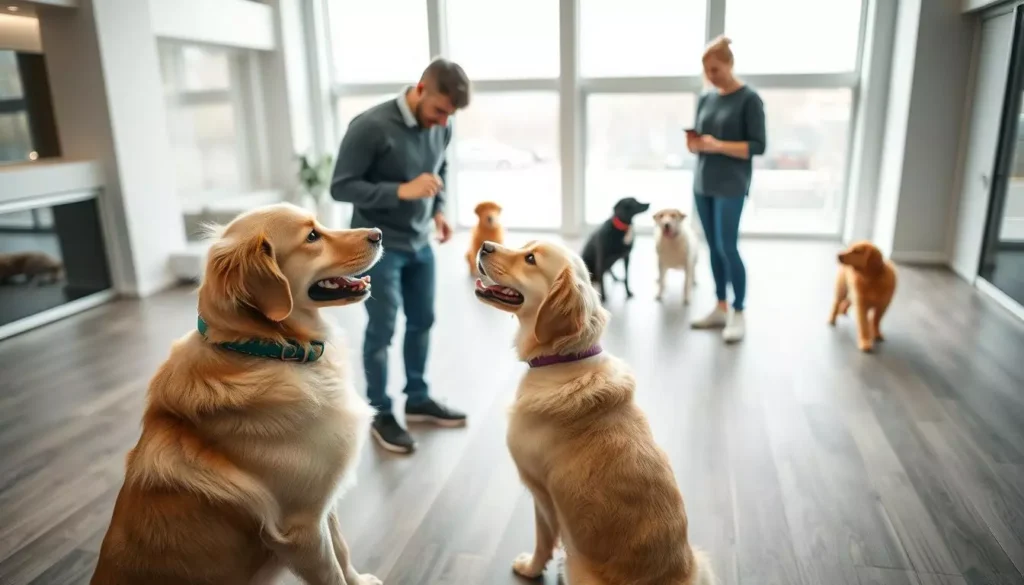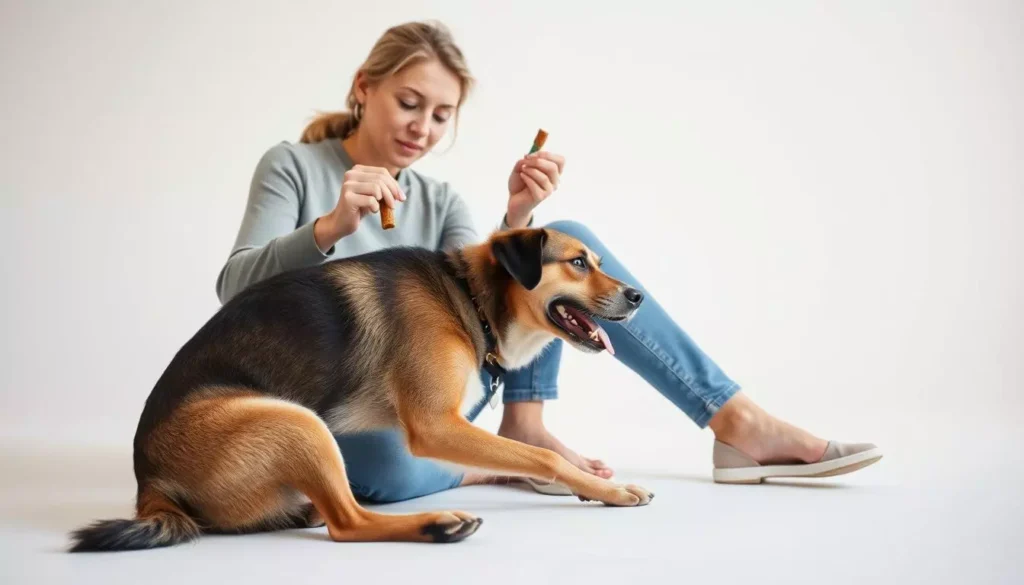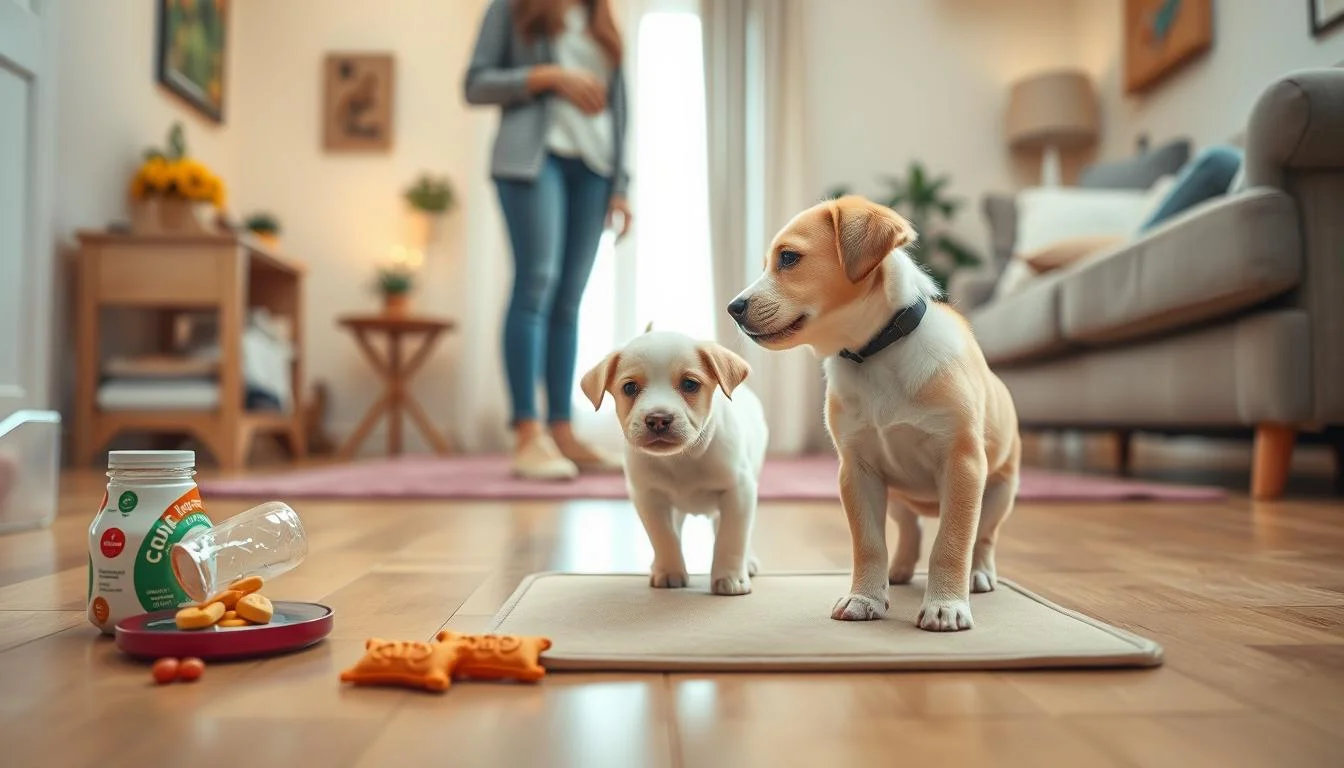
When I first got my puppy, I thought potty training would be easy. But, dogs don't naturally go to the bathroom where we do. My living room rug became a place of patience and learning.
I discovered that setting clear rules and rewarding quickly was key. I'd leash my puppy to a spot, wait quietly, and reward her right away. Waiting too long to praise or give treats didn't work well.
Tools like crates, baby gates, and cleaners from Nature’s Miracle helped a lot. They kept my house clean while teaching my puppy to go outside. With time, patience, and rewards like cheese, the accidents stopped.
Key Takeaways
- House-training rarely happens without clear rules and management.
- Reward immediately when the dog eliminates outside; timing is critical.
- Use crates, gates, and leash-to-owner supervision to prevent indoor accidents.
- Clean soiled spots with enzymatic cleaners to remove odor cues.
- Patience, consistency, and a simple schedule speed success in toilet training for dogs.
how do you potty train a dog
House training is a skill dogs learn. They don't know where to go at first. Teaching them helps protect your floors and keeps you calm.
Early on, it's key to manage their space. This makes the first days easier for both of you.
Overview of house training and why it matters
Housebreaking a puppy means setting clear rules. They need a spot to go and rewards when they do it right. Prevention is key: short sessions, crate time, and frequent trips outside.
This approach prevents accidents and speeds up learning.
Age and development: puppies vs. adult dogs
Puppies need to go out more often. A good rule is one hour per month of age. So, a 4-month-old puppy can hold for about four hours.
Very young pups need to go after waking, eating, playing, and crate time.
Adult rescues might need to start over. If a reliable adult suddenly has accidents, see a vet. Some adult dogs learn fast, while others need patience and a strict schedule.
What success looks like: goals and timeline expectations
Success means going to the right spot and responding to cues. As they grow, they can hold it longer. Some puppies learn quickly, while others take weeks or months.
I aim for two weeks without accidents before giving them more freedom. Nighttime control comes from daytime success and adjusting their feeding schedule. Positive rewards and consistent timing help them learn and stay on track.
Preparing for potty training: supplies and mindset
I start with essential items and a calm plan. The right supplies help us achieve early successes and reduce stress. I recommend a sturdy leash, high-value treats like cooked chicken or small cubes of cheddar, a properly sized crate, and an enzymatic cleaner such as Nature's Miracle to remove scent traces. For short-term indoor control, puppy pee pads and belly bands can help when I must be away.
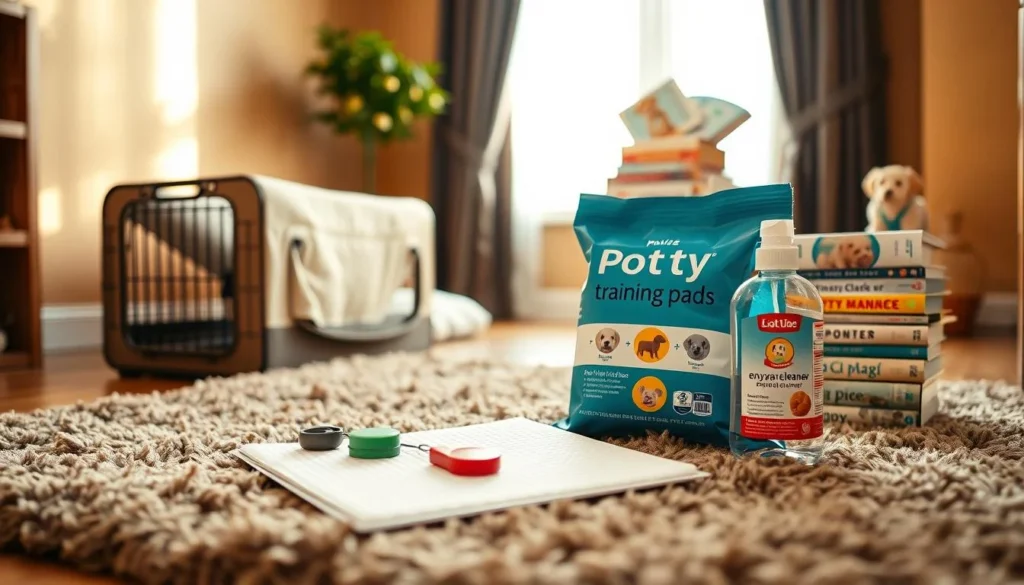
I see crate training as a positive habit, not punishment. The crate should let my puppy stand, turn, and lie down. I use partitions to shrink the space as the puppy grows. Crates give a safe den and cut down on unsupervised accidents while I reinforce outdoor habits.
My mindset is key, not just the equipment. I focus on positive reinforcement training and patient repetition. I never scold a puppy after an accident. That confuses them and harms trust. I reward correct eliminations with praise and treats right after they finish so the association is clear.
Choosing a single elimination spot speeds learning. I pick a quiet, accessible area and take the dog there every time. I use a short, consistent cue like “Go Potty” while the dog is eliminating to build a strong link between the command and the action.
I schedule feeding and potty breaks to create predictability. I take the puppy out first thing in the morning, after meals, after play, and before bed. That minimizes surprises and helps me phase out puppy pee pads without setbacks.
| Item | Purpose | Practical Tip |
|---|---|---|
| Sturdy leash | Take dog to elimination spot safely | Use a short leash to limit distractions on the walk |
| High-value treats | Immediate reward for correct elimination | Keep treats small and reserved for potty success |
| Crate | Safe den to prevent accidents | Select size for standing and turning; use partitions |
| Enzymatic cleaner | Removes odor cues that invite repeat accidents | Use products like Nature's Miracle or Eco-88 on soiled areas |
| Puppy pee pads | Short-term indoor management | Phase out pads gradually to avoid confusion |
| Belly bands | Manage marking or male incontinence | Use temporarily while reinforcing outdoor routine |
| Gates or pen | Limit roam and supervise easily | Create a small safe area with visible access to the crate |
Creating a potty training schedule and routines
I started with a simple potty training schedule early on. A routine helps a puppy know when to go outside. I link bathroom breaks to meals, naps, play, and bedtime.
Scheduling by age: how long dogs can hold it
Puppies can hold their bladder for as many hours as their age in months. For a 4 month old puppy, that's about four hours. I check more often to be safe.
For a 5 month old puppy, I plan for five hours. But I watch for signs they need to go. A 6 month old puppy can hold it for six hours. I never wait too long to take them out.
Key times to take the dog out: wake, after eating, after play, before bed
I take dogs out in the morning, after meals, naps, and play. I also take them out before bed. These times help them learn when to go.
If a puppy starts pacing or sniffing, it's a sign they need to go. I take them out quickly and praise them. At night, I keep things calm so they learn it's serious.
Adjusting the schedule for work, travel, and weather
When I'm away from home, I arrange a midday walk. This keeps the routine going and prevents accidents. It helps the puppy stay on track.
In bad weather or when traveling, I find indoor spots or take extra trips. I plan dinners early to avoid accidents at night. Even with changes, I keep a close eye on them until they adjust.
Crate training for dogs as a housebreaking tool
I use a crate as a key tool for housebreaking a puppy. It taps into their natural den instincts. A crate limits access to the home and reduces indoor accidents while teaching an outdoor routine.
I never punish with the crate. Instead, I make it welcoming with safe chews and toys like a Kong. This keeps downtime positive.
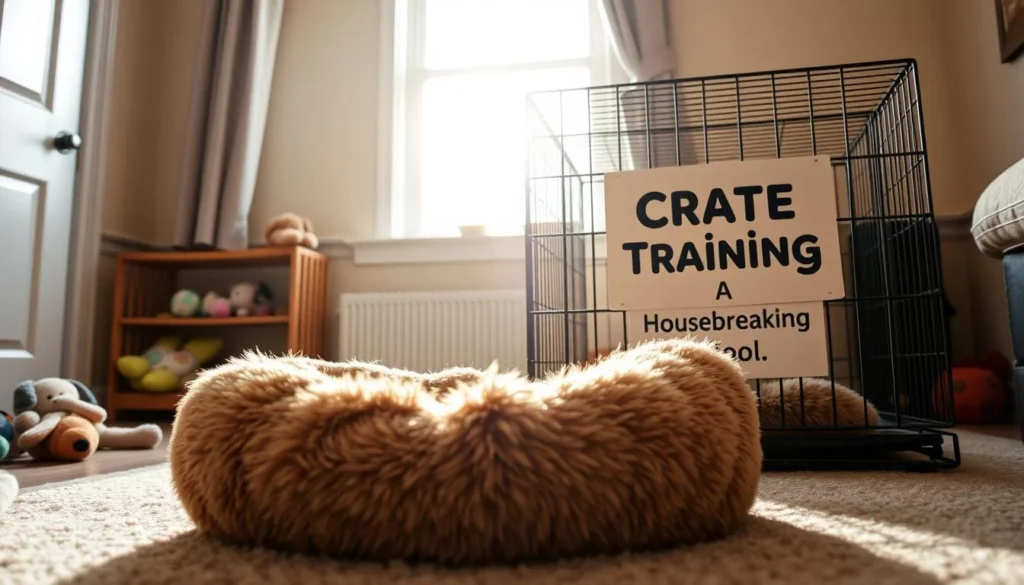
Crates are effective because dogs avoid soiling their sleeping area. I pair crate time with a tight schedule of short confinement, potty breaks, and praise outdoors. This speeds up learning and reduces stress for both puppy and owner.
Choosing the right crate size is crucial. The crate should let the dog stand, lie down, and turn around without extra room. If it's too large, a puppy might use a corner as a toilet.
I use crates with partitions to adjust the space as the puppy grows. This lets me shrink the interior as needed. Partitions help me adjust the crate size as the puppy gains bladder control.
Introducing the crate gradually prevents fear and resistance. I start by feeding near the crate, then inside it, and then close the door for short stretches. I only lengthen sessions if the puppy stays calm. If they whine, I treat it as a possible bathroom signal.
Troubleshooting a soiling crate means checking the schedule and physiological limits. If a puppy soils the crate, I assess confinement length and their control outside. I tighten supervision, shorten confinement, and increase outings until accidents stop.
Rescue dogs with prior kennel history may need a full retraining plan. I focus on consistent outings, clear praise for outdoor elimination, and patience. For overnight accidents, I evaluate confinement length and the last outdoor break to avoid leaving the puppy in a crate longer than they can hold.
| Topic | Practical Tip | Why it Matters |
|---|---|---|
| Crate selection | Choose one where crate size allows standing, turning, and lying down | Prevents corner elimination and supports comfort |
| Partitions | Use partitions to reduce space as puppy grows | Mimics den size and discourages soiling crate |
| Introduction steps | Feed near then inside; short closed-door sessions; add toys | Builds positive association and reduces anxiety |
| When accidents occur | Shorten confinement, increase potty breaks, review schedule | Restores progress and identifies physiological limits |
| Rescue dogs | Start fresh with predictable outings and praise | Overwrites prior kennel habits and re-establishes house rules |
Using positive reinforcement training effectively
I teach potty habits with clear steps that build trust and fast results. Positive reinforcement training makes learning fun for dogs and simple for owners. I focus on timing, voice, and rewards so the dog links elimination outside with a positive outcome.
I time rewards to land within one to two seconds of the dog finishing outside. Immediate feedback creates a strong association between the action and the reward. I use high-value treats for early wins and small, frequent bites to avoid upsetting a puppy's stomach.
I use verbal praise as an emotional cue. I cheer, clap softly, and say the cue words consistently while the dog is eliminating. Over time the cue words become a reliable prompt that helps the dog know what I want.
Balancing food rewards with regular meals keeps nutrition on track. I keep a steady feeding schedule, use treats as training supplements, and reduce meal portions slightly when giving many training treats. As the behavior stabilizes, I shift from treats to mostly verbal praise and occasional rewards.
Play or freedom after success works as a reward too. If my dog wants to run and explore after going potty, I let them. That extra time outside reinforces the routine without adding calories from treats.
Below is a compact guide I use to align reinforcement, timing, and food management during house training.
| Focus | What I Do | Why It Works |
|---|---|---|
| Timing rewards | Deliver treats within 1–2 seconds after elimination | Creates a direct link between going outside and getting rewarded |
| High-value treats | Use meat or cheese for early successes; switch to small kibble bites later | Boosts motivation during learning without overfeeding |
| Verbal praise | Use cheerful phrases and consistent cue words during elimination | Builds an auditory cue that prompts the behavior on command |
| Meal balance | Keep regular meals; adjust portions if many training treats are used | Maintains nutrition and predictable elimination rhythms |
| Fade strategy | Gradually replace treats with verbal praise and occasional rewards | Helps the dog sustain behavior without dependence on food |
Managing accidents and cleaning to prevent repeat spots
I stay calm when I find a mess. I never yell at the dog after it happens. Quick cleanup keeps our bond strong and stops future accidents.
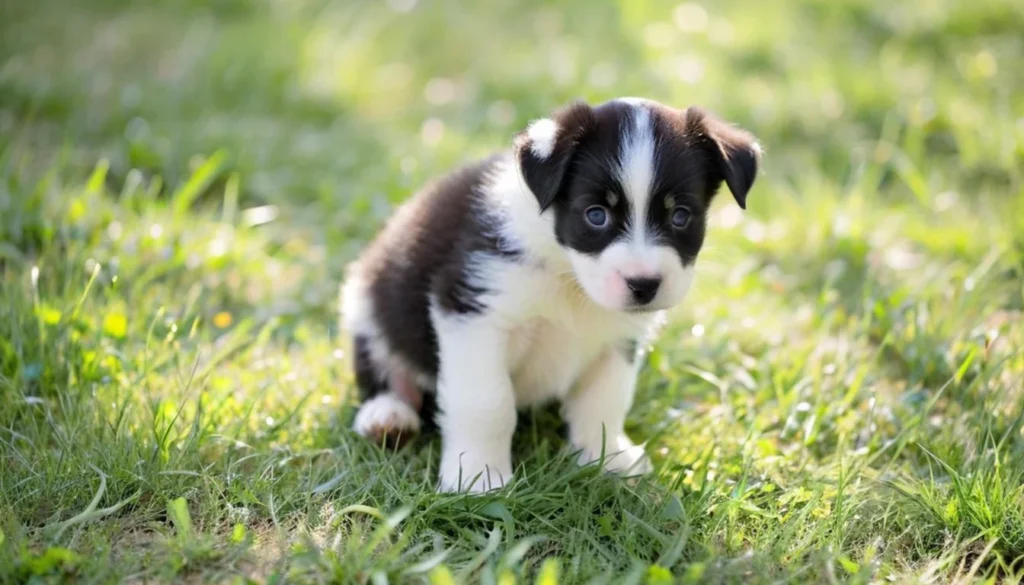
If I catch the dog in the act, I gently stop them and take them outside. If they finish outside, I give them a treat right away. This teaches them the right spot without fear.
I clean up urine by blotting it first and then using an enzymatic cleaner. Products like Nature's Miracle and Eco-88 remove the scent, so dogs won't go back. I follow the cleaner's instructions and let it sit long enough to work.
For spots that keep coming back, I use belly bands for males or diapers for females. I also limit the dog's freedom until they learn the new routine. These steps help reduce damage while I retrain them.
I keep a journal of every accident and success. Patterns often show what triggers them, like playtime or visitors. When I find these patterns, I adjust the schedule to prevent more accidents.
I don't punish the dog because it can make them hide and go in secret. Using an enzymatic cleaner and consistent redirection keeps our home clean. With patience and the right products, the same spots won't attract the dog anymore.
Potty training techniques for different ages and breeds
I break down age-specific strategies so you can match training to your dog's needs. Each age group has predictable limits and milestones. A short, steady plan wins more than a long, sporadic push.
how do you potty train a 4 month old puppy: At four months, I expect frequent trips outdoors and close supervision. A 4-month-old puppy can usually hold for about four hours. I use a leash to guide them to the chosen spot, reward the instant they finish, and limit free access inside. Crate time helps when I cannot watch them, and I keep meal and play times consistent to build rhythm.
how do you potty train a 5 month old puppy and how do you potty train a 6 month old puppy:
Between five and six months, I watch for longer holds and more control. Most pups can stretch to five or six hours, so I add measured freedom while keeping a clear schedule tied to feeding and naps. I resist full house access until the dog shows steady success for weeks. I still reward every correct outing so the behavior stays strong.
how do you potty train a 2 year old dog and working with adult rescues:
When I train a 2 year old dog, I first rule out medical causes for accidents. Adult rescues may need gentle re-teaching of basic routines. I use crates, a strict walk schedule, and high-value rewards. Some rescues from shelters or puppy mills benefit from extra structure and slow exposure to freedom while they relearn house rules.
Special considerations for small breeds potty training and how do you potty train a dachshund puppy:
Small dogs like dachshunds have small bladders and fast metabolisms. I plan more frequent outings and close monitoring. Indoor potty options such as pads or a small potty box can bridge training, especially in bad weather or for tiny breeds. I treat belly bands or diapers as short-term management tools while I work toward consistent outdoor elimination.
I use the same core rules across ages: consistent timing, immediate rewards, supervised freedom, and patience. Those steps let me tailor training to a puppy's development, an adolescent's growing control, or an adult dog's need to relearn good habits.
Puppy pee pads, indoor options, and transitioning outside
Many city dwellers and those stuck inside during winter ask about puppy pee pads and indoor potty boxes. These tools can save floors and nerves when going outside is hard. It's important to have a clear plan from the start to teach the puppy the right spot.
I recommend puppy pee pads for short-term needs like living in an apartment or during winter. Place the pad near the door, reward the pup for using it, and keep sessions frequent. For dachshund owners, pads are helpful because these dogs are small and may struggle with long walks at first.
When pads become a habit, moving outside can be tough. I follow Dr. Mary Burch’s advice and move the pad gradually toward the exit. Then, I move it just outside and reward the pup for eliminating there. This creates a clear path from indoor pad to outdoor spot.
Indoor potty boxes are great for tiny breeds and when it's too cold to go outside. Keep the box clean, use the same cue word as outdoors, and reward heavily for correct responses. For dachshund owners, a consistent cue and timing are more important than the surface.
Here's a step-by-step plan to phase out indoor aids and support transitioning outside:
- Start with a designated pad or box placed near your exit.
- Reinforce each success with treats and a simple cue.
- Move the pad incrementally toward the door over several days.
- Shift the pad just outside, then remove it after outdoor success repeats.
- Keep supervision tight while pads remain in the house to avoid accidents.
Below is a compact comparison to help decide between pads and indoor potty boxes.
| Feature | Puppy Pee Pads | Indoor Potty Boxes |
|---|---|---|
| Best use | Apartment living, short-term indoor options winter | Very small breeds, severe weather, mobility limits |
| Ease of phase-out | Moderate; needs gradual moving toward exit for transitioning outside | Easy if cue and surface match outdoor spot; keep clean for consistency |
| Training risk | Can reinforce indoor elimination if left indefinitely | Lower if used temporarily and paired with outdoor rewards |
| Suitability for dachshunds | Helpful early on; limit access to speed outdoor training | Very useful for how do you potty train a dachshund puppy during harsh weather |
| Maintenance | Frequent replacement and odor control needed | Regular cleaning and litter refresh required |
If you choose pads, plan their removal before giving your dog full outdoor-only freedom. I watch for consistent outdoor success before I stop rewards. That final step makes the outdoor habit stick.
Common potty training problems and troubleshooting
I talk about common potty training issues and how to solve them. Even small problems can seem big, but with the right steps, progress is easy to see. Here, I share tips for dealing with marking, using belly bands, and when to see a vet.
Marking versus elimination and using belly bands
First, I look at the pattern. Marking is quick, with small sprays, often on furniture. Full elimination is when they empty their bladder fully, usually in one spot. Knowing the difference helps in planning.
While training, I suggest using tools like belly bands. They help with damage but don't teach good habits. For females or heavy soiling, dog diapers can be a temporary solution. They should not be a permanent fix.
Try to catch your dog in the act. A calm interruption and a walk outside can help. Praise them for going outside to build a positive association.
Regression after changes, stress, or new environments
Regression often happens after big changes like moving or new guests. Dogs struggle with sudden changes and may forget what they learned. When I see regression, I increase supervision and potty breaks.
I limit free roam and go back to crate training until they settle. Regular outdoor trips and consistent cues help them recover faster. Dogs show guilt because of our tone, not because they're trying to be bad.
When to consult a vet for sudden or persistent issues
If a trained dog starts soiling suddenly, a vet visit is a good idea. Medical issues like UTIs or diabetes can cause accidents. A vet check can rule out illness before starting behavior plans.
For puppies that have trouble learning by several months, a vet visit and a trainer or behaviorist referral are suggested. Persistent problems need both medical and professional help.
Advanced tips and long-term habits for success
I use advanced tricks to keep good behavior and prevent backsliding. These steps help dogs move from close supervision to trusted freedom. They also make accidents rare.
I start with long leash training for shy or easily distracted dogs. A 25-foot leash gives privacy and lets the dog find the right spot. I keep play low before a potty chance and reward immediately when they go.
Second dog modeling can speed learning when I bring a calm, well-trained companion. I watch for pre-potty play between dogs and stop it. This helps the trainee focus on elimination. But, the trainee always needs direct rewards for success.
I keep a simple potty training journal to spot patterns in accidents and wins. I log times, activities before the trip, and where accidents happen. Two weeks of clean records tells me the dog is ready for more unsupervised access.
When I give more freedom, I do it slowly. I open one room at a time and keep to the schedule. Gradually increasing freedom means small steps, steady rewards, and close watch during life changes.
To protect long-term habits, I tighten supervision when routines shift. This includes travel, work changes, or guests. If setbacks occur, I return to basics. This includes controlled feeding, leash-to-spot trips, crate when unsupervised, and consistent rewards for outside elimination.
Conclusion
Successful potty training is all about being consistent, rewarding immediately, and being patient. When I talk about potty training a dog, I mention routines based on age and activities. I also talk about using a crate to limit access and having a clear spot for them to go.
These basics help reduce accidents and make progress easy to see. My tips for dog potty training include positive reinforcement and keeping the area clean. I use enzymatic cleaners on accidents and keep a log to track progress.
I adjust the schedule for nights or bad weather. Puppy pads can be helpful in the short term, but I stop using them when focusing on outdoor training.
If accidents happen, I increase supervision and reward good behavior. If problems persist, I might talk to a vet. With the right approach, dogs can learn to use the bathroom reliably in a short time. This makes for happier, cleaner years together.