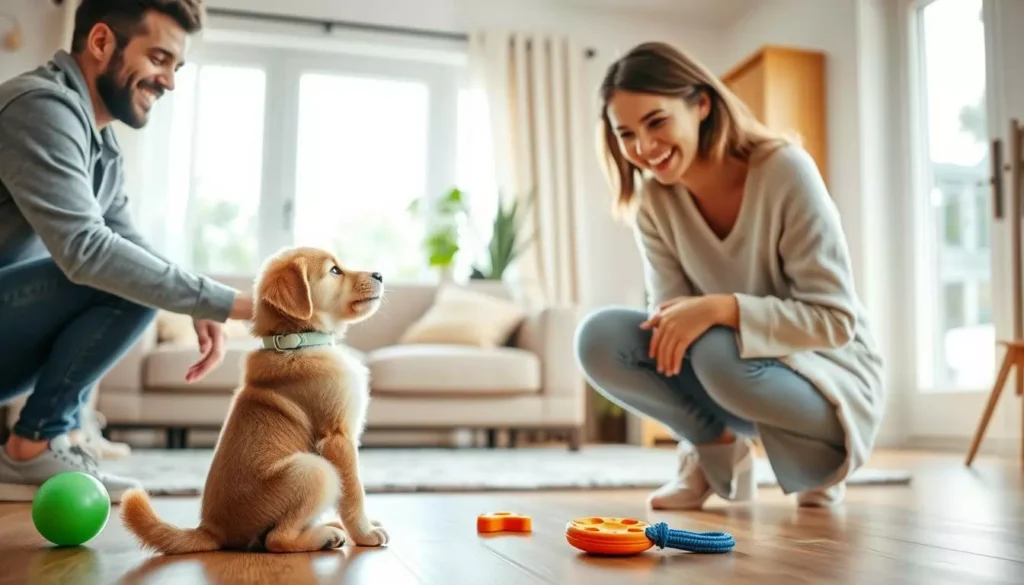
I remember the first night my new Labrador mix arrived. She was soft and scared, with a blanket tangled around her tiny paws. I wanted to teach her in a way that built trust, not fear.
This led me to learn about positive reinforcement for dogs. I looked for the best puppy training methods I could find.
Positive training for puppies means rewarding good choices. This could be treats, praise, or a gentle pat. It helps the puppy connect the action with something pleasant.
I found that short sessions and clear cues like "sit" and "come" work well. An immediate marker, like a click or "Yes!", makes learning fun and fast.
Timing is key: rewards should come right after the good behavior. Treats should be small and low-calorie. Crate training helps with housetraining and keeping calm.
Ignoring bad behavior stops it from getting worse. But, I never use physical punishment. It breaks trust and can lead to fear or aggression.
Key Takeaways
- Start with reward-based approaches that build trust and motivation.
- Keep sessions short (about 10 minutes) and focused for best results.
- Use a marker (clicker or word) and immediate, small rewards.
- Teach simple one-word cues first and be consistent across the household.
- Avoid physical punishment; management and redirection work better.
Why positive reinforcement works for puppies
I teach owners to focus on what to add, not what to take away. Positive reinforcement for dogs means giving something the puppy values—treats, play, or attention—right after the desired action. This simple timing makes the behavior more likely to be repeated.
Short, consistent rewards and clear markers help puppies link action to outcome in seconds.
Definition and core idea
At its core, training puppies with positive methods rewards desired behavior so it grows. The operant idea is simple: “positive” means you add something, “reinforcement” means the action gets stronger. I use short commands and immediate rewards.
If the behavior does not increase, the reinforcer or timing needs changing.
Benefits for relationship and behavior
Positive dog training strategies build trust. Puppies learn that cooperating gives good things, which lowers fear and stress. I find behaviors stay reliable longer when dogs feel safe and motivated.
Group classes, crate training, and planned practice sessions give structure. These supports let puppies generalize lessons across rooms, people, and distractions.
How positive differs from negative reinforcement and punishment
People often confuse terms. Negative reinforcement removes something to strengthen a behavior, while punishment aims to reduce behavior. I prefer reward-based approaches for early learning because punishment risks fear and confusion.
Some experienced trainers use mild, controlled consequences later to proof cues in distracting settings. I recommend planning real-world steps so positive methods lead to dependable results in everyday life.
When to start training your puppy
I start training a puppy the moment they arrive home. I focus on basic commands like sit, stay, and come. These skills are the foundation for what puppy school will build upon. Training sessions are short, about ten minutes, to keep it fun and prevent boredom.

I suggest training in a quiet area with minimal distractions. Use one skill per session, lasting around five minutes. Pair a clear marker with a tasty treat to reward the puppy. Let the puppy's interest guide your choice of rewards.
Best age to begin
Puppies are ready to learn as soon as they settle in, usually around eight weeks. I start with basic cues early but keep expectations low. Lessons are short and frequent, fitting the puppy's growing attention span.
Setting realistic expectations
Getting reliable in real-world situations takes time, weeks or months. Don't expect a puppy to master off-leash skills right away. Temperament and distractions affect learning speed. Keep track of progress and adjust your training as needed.
I recommend combining home practice with puppy classes. Classes are led by certified trainers. Use high-value rewards for quick gains, then practice in different settings for lasting success.
For consistent results, be consistent with training sessions. Stay patient and use puppy training tips that match your dog's learning pace. These habits are key to successful training and prepare you for professional dog training if needed.
Essential supplies for positive puppy training
I prepare a small kit before each training session. The right supplies help us move forward, reduce stress, and make training fun. It's all about making it enjoyable for both of us.
Treats and reinforcers
I carry small, low-calorie treats like cooked chicken, carrot slices, blueberries, or apple. I change flavors to keep my puppy interested. The best treats are saved for new or hard skills.
I keep treats close and reward my puppy quickly after they do something right. This quick reward system works well in short, focused training sessions.
Markers and clicker training
I use a clear marker, like a clicker or a specific word, to signal when my puppy does something right. This marker, paired with treats, becomes a strong signal for good behavior.
Clicker training is cheap and precise. For early lessons, I train in a quiet room. This helps the marker and reward connect without distractions. Later, I add distractions to test their understanding.
Equipment and environment
I use basic tools like a sturdy leash, a safe collar, crates, and baby gates. These tools help prevent bad habits while teaching good ones.
I avoid complex tools like prong or remote collars unless a pro is involved. Simple gear and controlled spaces keep training safe and consistent.
Positive training for puppies
I teach puppies with short, clear goals and rewards. Start each session with a single focus. Keep exercises upbeat so the puppy stays engaged and curious. This approach makes core commands for puppies easier to learn and helps build trust.

Core commands to teach first
Begin with a few practical cues: sit, stay, down, off, watch (eyes on me), up (stand up), come, heel/walk, leave it, and drop/give. Use short direct commands and immediate reinforcement. I rely on a marker, a treat, and a calm voice to link behavior to the command.
How to structure a training session
Plan sessions of about 10 minutes. Pick one skill and work on it for roughly 5 minutes, then switch or stop. Use a marker to mark the exact moment the puppy gets it right, give a primary reinforcer, then add verbal praise.
End while the puppy is still enjoying training. Take short breaks and avoid practicing when your puppy is distracted or uninterested. Track small gains so you can increase difficulty and reliability over time.
Using consistency and household agreement
To generalize behaviors, raise distractions and change locations gradually. I start with high-value treats and then proof behaviors in different rooms and outdoor settings. Household agreement is critical; everyone must use the same cues, rewards, and rules.
Consistent naming, timing, and response prevent mixed signals. When the whole family follows the plan, structured puppy training becomes routine and the puppy learns faster. Consistency in dog training is the backbone of lasting success.
Types of rewards and how to rotate them
I keep training lively by offering a mix of incentives that match a puppy’s tastes and energy. This approach covers edible treats, verbal praise, gentle touch, and short bursts of play. Varying reinforcers prevents boredom and keeps learning fresh while I work on consistency and clear cues.
I use small, tasty bits like cooked chicken, plain Cheerios, or kibble from their daily allotment during early sessions. High-value treats speed learning when teaching new skills. I switch to lower-value rewards or intermittent treats as skills become reliable.
Food works well when a puppy is motivated. Praise and petting shine when the dog is already satisfied or distracted. Toys and short play sessions make excellent reinforcers for active breeds. Picking the right option at the moment is essential to keep the response strong.
I rely on precise signals to link action and reward. A clicker, a sharp “yes,” or an upbeat verbal marker tells the puppy exactly which behavior earned reinforcement. Quick delivery within a second or two is critical to preserve the association.
In planned practice I choose a reinforcer that fits the goal of the exercise. For impulse control or calm tasks, soft praise and a single kibble piece work. For fast-paced shaping sessions, high-value treats or tug play keep motivation high. Short sessions help me maintain intensity and focus.
Monitoring calories matters when training frequently. I count small training treats toward the daily ration and reduce meal portions if needed. Low-calorie options, like plain carrots or a piece of dry kibble, let me reward often without risking weight gain.
I rotate rewards across sessions and within a session to preserve novelty. This rotation helps transition a puppy from working for a preferred treat to accepting ordinary rewards. That step is vital when proofing behaviors around distractions.
Below I show practical comparisons to help you choose and rotate rewards while keeping reward timing in training and managing puppy calories in mind.
| Reward Type | Best Use | Timing Notes | Calories & Management |
|---|---|---|---|
| High-value food (chicken, cheese) | New behaviors, hard proofing, strong distractions | Deliver within 1 second of marker for clear association | Offer tiny pieces; count toward daily caloric intake |
| Everyday kibble | Repetition, shaping, long sessions | Work best when used immediately after marker | Use as part of meal; reduce meal portion to balance calories |
| Verbal praise | Quick confirmations, calm behaviors, social reinforcement | Pair with treat during learning, then fade treat over time | No calories; useful when puppy is already fed |
| Physical touch (petting) | Bonding, calm cues, low-arousal tasks | Give immediately after the marker to reinforce calmly | Zero calories; effective for motivated, touch-loving dogs |
| Toys & play | High-drive breeds, recall, fetch training | Start play within seconds; end play while excited to maintain value | No food calories; use as alternative when managing puppy calories |
Common puppy training techniques with positive methods
I help owners teach puppies using positive methods. We start with short, focused sessions in quiet places. This helps puppies learn and succeed.

First, we use markers and timing. A clicker or a word marks the exact moment a puppy does what we want. We pair this with a treat to make it clear.
I use three main methods based on the goal and the puppy's personality. These methods build on each other as the puppy learns more.
Clicker shaping and capturing
Clicker shaping rewards small steps towards a behavior. We click and treat for tiny actions. This helps build complex behaviors from simple ones.
Capturing waits for the puppy to do something on its own. We click and reward the moment they do it. This is great for natural actions like sitting or spinning.
Luring and fading the lure
Luring uses a treat to guide the puppy. We hold a treat to teach a sit, down, or follow. The puppy learns the action and the cue together.
Once the puppy knows the behavior, we fade the lure. We move the hand less and reward from different spots. Eventually, the puppy responds without seeing the treat.
Proofing behaviors in different environments
Proofing tests skills in new places and with distractions. We start inside, then move to the yard, and then add distractions.
We use high-value rewards at first. As the puppy becomes reliable, we switch to less consistent rewards. This helps the behavior stick even when treats are not always there.
| Technique | When to Use | Key Steps | Common Pitfall |
|---|---|---|---|
| Clicker shaping | Teaching new, multi-step behaviors | Pair marker, click approximations, raise criteria slowly | Clicking too late or inconsistent marking |
| Capturing | Reinforcing accidental but useful offers | Wait, mark exact moment, reward immediately | Missing the moment; slow reaction |
| Luring | Quickly shape simple responses | Guide with treat, add cue, fade hand motion | Failing to fade lure so dog depends on treat |
| Proofing | Generalizing behaviors across settings | Gradually add distractions, raise difficulty, vary rewards | Rushing environment progress; low success rate |
How to handle unwanted behaviors without punishment
I teach owners to stop rewarding bad actions and focus on good ones. Attention is a big reward for puppies. If a puppy barks or nips for attention, I ignore them until they calm down and act right.
I use a clear command and an alternative action. When a puppy jumps on guests, I ask for a sit or a touch cue. This teaches them what to do instead of jumping.
I use tools like crates and leashes to prevent bad habits. These tools help puppies learn without getting into trouble. They also keep the puppy safe in busy homes.
I start training in quiet places and then move to busier areas. If ignoring and redirecting don't work, I check if the reward is strong enough and the cue is clear. Sometimes, all it takes is a bit more reward or shorter training sessions.
When safety is a concern, I teach reliable cues like "sit" or "look". These cues stop lunging or chewing on things they shouldn't. By repeating these cues and rewarding the right behavior, puppies learn to stop unwanted actions.
Keeping training consistent is key to long-term success. I ask family members to use the same cues and ignore bad behavior. This approach keeps training steady and makes it stress-free for everyone.
Addressing puppy aggression towards other dogs with positive strategies
Many owners worry when their young dog shows aggression towards others. I teach them to understand body language and control distance. I also reward calm behavior to help them feel better around other dogs.
Understanding triggers and thresholds
I figure out what makes the puppy react. It could be fast movements, direct eye contact, or crowded areas. I keep the puppy safe and focused, taking small steps to build trust.
Desensitization and counterconditioning
I introduce the puppy to other dogs at a safe distance. I give treats or a favorite toy when a dog appears. This helps the puppy associate other dogs with positive things. I gradually get closer, rewarding calm behavior.
When to seek professional dog training help
If aggression gets worse, safety is at risk, or progress stops, I suggest professional help. A skilled trainer can assess the situation and create a safe plan. They can also provide tools and strategies to manage the behavior.
Balancing positivity with real-world reliability
I aim to connect calm practice with everyday life. Positive training builds trust and many useful behaviors. But, it's crucial to test these skills in public places.
First, I focus on low-distraction training at home. Short, frequent sessions help a pup learn cues. I reward them precisely to mark correct actions.
When they're reliable at home, I introduce more distractions. This helps them learn in real-world situations.
I plan outings carefully, starting with quiet places. A quiet park bench comes before a busy farmers market. I use high-value treats and praise to teach them to choose me over distractions.
Trainer perspective and limits
No single method works for every challenge. Experienced trainers know the limits of all-positive training. For some dogs, a balanced approach speeds up learning.
I use corrections that are fair and evidence-based. A well-timed leash cue or brief interruption can help. I introduce these tools carefully, only when they improve learning without harming trust.
Safety and ethical considerations
Safety is my top priority in dog training. I avoid aversive devices that can cause fear or pain. I watch for signs of stress and make sure training is healthy.
If training stalls or aggression appears, I recommend seeking professional help. A certified trainer or a veterinary behaviorist can create a plan that balances effectiveness with welfare.
| Stage | Focus | Example Tools |
|---|---|---|
| Controlled practice | Timing, short sessions, clear markers | Clicker, low-distraction treats, crate |
| Guided generalization | Increase distractions, maintain reward value | High-value treats, toys, gradual exposure |
| Real-world reliability | Consistent cues under unpredictability | Balanced reward-based training, ethical corrections |
| Welfare checks | Monitor stress, safety in dog training, health | Rest breaks, calorie tracking, veterinary consult |
Effective puppy training tips I use and recommend
I make training easy and simple for owners to do at home. Short, fun sessions help puppies focus and feel confident. My methods are based on positive training and years of experience.
Keep sessions short, frequent, and fun
Each session lasts about 10 minutes. Stop when your puppy still wants to learn. Ending on a success note is key.
Watch for signs like yawning or losing interest. These mean it's time to stop and try again later.
Track progress and adjust reinforcers
I keep track of what works and what doesn't. If a cue is hard to learn, I make the reward better. Start in a quiet place and move to busier areas later.
Consistency, patience, and celebrate small wins
Use the same cues and rewards everywhere. Avoid rewarding bad behavior. Celebrate small victories to keep everyone motivated.
- Tip: Use a clicker or short marker word immediately before a treat to speed learning.
- Tip: Rotate low-calorie treats to prevent satiety and maintain interest.
- Tip: If aiming for off-leash reliability, plan staged proofing and consult certified trainers when needed.
Conclusion
Positive training for puppies is key to building strong skills and trust. Start early and use clear markers and treats to motivate. Keep training sessions short to avoid stress.
Crates and puppy classes help reinforce good habits. This makes real-world practice easier for your puppy.
Timing and consistency are crucial in puppy training. Reward your puppy right away and avoid bad behavior. Use different treats to keep them interested.
Keep track of how your puppy is doing and change your approach if needed. Positive training helps your puppy stay well-behaved and happy.
But remember, every dog is different. Some may need extra care or professional help. Always put your puppy's safety and happiness first.
If you're unsure, talk to a certified trainer. With patience and the right methods, your puppy can become a well-behaved friend.