I remember the night my two dogs fought in the kitchen. The sound of their teeth on fur was terrifying. The silence that followed made me even more scared. I was worried about someone getting hurt, losing a dog, or failing as a pet owner.
This fear pushed me to learn everything about aggressive dog training. My goal is to help you learn how to make your home safer and calmer. I want to teach you how to manage aggressive behavior in your dogs.
Aggressive behavior includes fights, mounting, blocking, and more. It's important to address all these behaviors when two dogs live together. This way, you can ensure a peaceful home.
Changing your dogs' behavior takes time. It can take weeks or even months. But with patience and consistent training, most dogs can improve.
This article will guide you on how to train your dogs. We'll use evidence-based methods, behavior modification, and structured routines. We'll also talk about the importance of exercise, obedience, and sometimes, medication or professional help.
Key Takeaways
- Define aggression broadly—fights and subtle dominance behaviors both matter.
- Expect gradual progress: improvements usually take weeks to months with consistent effort.
- Prioritize safety first: management reduces risk while training reshapes behavior.
- Combine veterinary input, behavior modification, and structured routines for best results.
- Every household member must use the same strategies for lasting change.
Understanding why dogs fight: causes of interdog aggression
I explore why dogs fight and what owners can do. Spotting triggers and signals helps stop small issues from becoming big fights. I share common cues, root causes, and changes in the home that affect dog relationships. This way, you can take steps to make your home safer.
Common triggers and signals
Competition for things like food, toys, and attention often leads to fights. Even excitement during greetings or play can turn into aggression. This is common in homes with more than one dog.
Body language is key. Look for stiff bodies, staring, raised hackles, and baring teeth. These signs often mean a dog is about to get aggressive.
Root causes: fear, dominance, resource guarding, hormones, and medical issues
Fear and anxiety cause many fights. Dogs may act aggressively to feel in control. Separation anxiety and phobias can make things worse.
Trying to establish a social order can seem like dominance struggles. But, a dog may show deference in some situations and compete in others. Resource guarding is a big predictor of fights.
Hormones play a role too. Intact males or females in heat may be more assertive. Talking to a vet about spaying or neutering can help.
Medical issues can also change a dog's behavior. Pain from arthritis or injury can make a calm dog snap. A vet visit is important to check for health problems.
Household changes and social maturity
Changes like adding a new dog or losing a family member can upset the balance. Dogs usually mature around three years old. This can lead to new aggression.
Poor socialization or past trauma can make dogs more likely to fight. How owners react is crucial. Inconsistent or harsh responses can make things worse.
| Trigger or Cause | Signs to Watch For | Practical First Steps |
|---|---|---|
| Resource competition (food, toys, owner) | Stiff body, staring, blocking, mounting | Separate feeding, structured access, nilif-style training |
| Fear and anxiety | Avoidance, growling, sudden lunges | Desensitization, counter-conditioning, vet check for anxiety |
| Dominance/pack dynamics | Posturing, standing over, persistent challenges | Consistent rules, predictable leadership, supervised interactions |
| Hormonal influences | Heightened reactivity around intact dogs or heat cycles | Discuss spay/neuter with your veterinarian, monitor interactions |
| Medical causes (pain, illness) | Sudden behavior change, reluctance to move, guarding | Immediate veterinary exam, pain management, adjust routines |
| Household changes & social maturity | New conflicts after a life change, shifting tolerance at ~3 years | Slow introductions, clear routines, monitor for escalation |
| Owner contributions | Inconsistent corrections, high-arousal responses | Train calm handling, avoid reinforcing aggression, seek behavior help |
Initial safety assessment and veterinary checkup
I start by checking for immediate dangers and setting up a vet visit for aggressive dogs. A calm vet exam helps find if pain or illness is causing the dog's behavior. I ask the vet to check for arthritis, dental pain, thyroid issues, and other mood-affecting conditions.
Next, I document the dog's bite history. I note who was bitten, when, how severe it was, and the situation. This helps spot patterns and decide if separating or rehoming the dog is needed.
I look for areas in the home where fights often happen. Places like food bowls, high furniture, doorways, and window perches can be trouble spots. I test barriers like baby gates and crates to see if they help reduce tension and provide a safe escape for each dog.
If medical issues are found, I talk with the vet about treatment options before starting behavior work. Good communication between me, the vet, and any trainers or behaviorists is key. It helps shape the plan for dog behavior therapy and training.
I teach everyone in the household how to safely remove the dogs and what to do in an emergency. Simple scripts for handling confrontations help reduce panic and keep everyone safe.
Finally, I consider how predictable the triggers are. If bites are severe or unpredictable, safety is the top priority. In such cases, I look into intensive dog behavior therapy or consult a certified animal behaviorist to create a safe plan.
Immediate management: preventing fights and reducing triggers
I start by creating clear, simple routines that cut risk right away. Short-term management keeps everyone safe while I work on deeper behavior change. These steps focus on preventing dog fights and give me time to plan effective dog aggression solutions.
I separate high-value moments so dogs cannot compete. Feeding, treat delivery, toy play and greetings happen apart until I can run safe sequential sessions. Crates, baby gates and separate rooms help. When dogs posture at a gate or window, I block visual contact and return them to calm spaces.
I limit excitement triggers like door greetings, car rides and rough play. I intervene early or put a dog out of reach when arousal rises. Controlled access to resources reduces conflict and supports managing territorial dogs without making the situation worse.
I rely on practical handling tools for fast, safe control. Gentle Leader head collars with a trailing leash let me guide a dog away quickly. I keep trailing leashes and separation plans within reach so I can act without delay. These tools help me prevent dog fights while training proceeds.
When bite risk is a concern, I introduce basket muzzles gradually and positively so the dog can pant and drink. I use muzzles as a temporary safety measure, not a fix. Pairing muzzles with training gives better dog aggression solutions in the long term.
I may use a citronella spray device to interrupt escalating fights when escape or physical separation is unsafe. I avoid harsh punishment that increases arousal. Safety tools are management first; they work best when combined with consistent behavior modification.
Below is a compact comparison to help choose management options based on typical needs and goals.
| Situation | Management Tools | Benefits | Notes |
|---|---|---|---|
| Separate feeding and rewards | Crates, separate rooms, staggered routines | Immediate reduction in resource fights | Use until sequential feeding system is reliable |
| Visual posturing at gates | Opaque barriers, close windows, block sight lines | Lower tension and fewer confrontations | Combine with calm cue training |
| High-arousal events (greetings) | Preemptive separation, handler-led calm introductions | Prevents escalation during peak excitement | Teach alternative greeting behaviors over time |
| Immediate break from a fight | Trailing leash on head collar, citronella spray | Quick separation with minimal handler risk | Train devices in non-crisis contexts first |
| Bite risk during training | Basket muzzle, supervised sessions | Safe hands-on work and reduced injury risk | Introduce positively and allow panting/drinking |
Starting a nothing in life is free program
I start a structured nothing in life is free dog training plan. It helps reset control and reduce tension between dogs. NILIF teaches dogs to earn rewards by responding calmly to my cues. This makes them rely on me more, reducing rivalry.
I begin with simple tasks before giving them food, toys, or petting. Dogs learn that sitting, staying, and coming get them what they want. This routine helps control aggressive behavior by managing when they interact.
I use a consistent marker word and quick timing. This helps dogs quickly understand what behavior gets a reward. This method is very effective in training aggressive dogs when combined with calm management and clear boundaries.
Practical exercises I use include:
- Run a 30- to 60-second obedience drill for one dog before feeding. Reward them for compliance, then let them eat.
- Do the same drill before leash attachment and before giving out toys. Withhold the item until they respond calmly.
- Ignore pushy or demanding behavior. Turn away and wait for a calm response, then reward them.
Once dogs can earn resources calmly, I start parallel sessions. They practice sits and waits side by side, earning rewards individually. This slow pairing helps avoid competition and supports behavior goals.
I keep sessions short and frequent, track small wins, and adjust pace as needed. These steps make NILIF a key part of aggressive dog training. It helps create safer, more controlled routines for dogs.
Using preference and resource sequencing to reduce competition
I'll show you a simple way to lower tension and teach dogs to wait. By setting predictable patterns, I reduce anxiety over scarce items. This helps a lot in multi-dog households.
I start by choosing which dog gets first access to a resource. Often, I pick the older or first-acquired dog. This consistent choice gives clear expectations. It makes outcomes predictable and cuts down on impulsive clashes.
I pair preference with a nothing in life is free routine. Dog A does a simple cue, like sit, then gets the food, leash, or attention. Dog B waits, then does the same cue and gets their turn. This builds patience and reduces grabs.
I track progress for about six weeks. If things don't improve, I switch preference to the other dog. Switching helps find the best order for calm. I keep all family members on the same plan to avoid mixed signals.
The goal is to teach waiting and remove surprise. When each dog knows the order, they worry less and fight less. This approach addresses common triggers and gives clear behavior targets to reward.
I use short sessions, low-distraction spots, and high-value treats for the first week. I gradually increase challenge while keeping the sequence identical. This steady escalation helps dogs generalize patience to daily life.
Below is a quick comparison chart I use to plan sessions and decide when to switch preference. It makes the sequence visible to everyone in the home.
| Step | Dog A (first) | Dog B (second) | Goal |
|---|---|---|---|
| 1: Entry | Quiet sit, leash clipped | Wait behind barrier | Predictable arrival routine |
| 2: Feeding | Wait, cue, then fed | Wait, cue, then fed | Prevent rushed access to bowls |
| 3: Treats | Single treat on cue | Single treat after cue | Teach turn-taking |
| 4: Attention | Short petting session | Short petting session | Reduce competition for owner focus |
| 5: Rest spots | First choice of bed | Second choice of bed | Lower fight risk over preferred places |
Desensitization and counter-conditioning between dogs
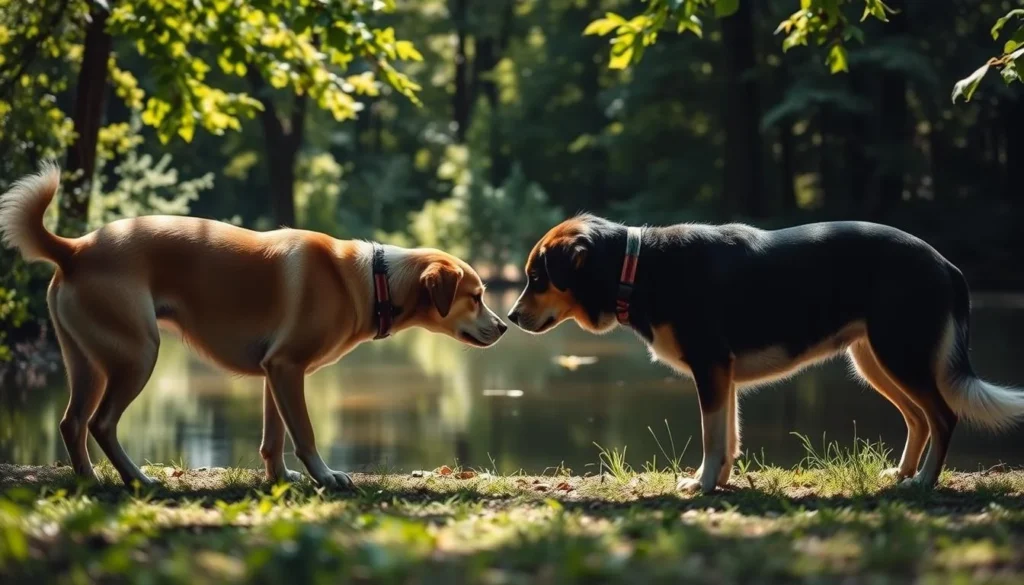
I show readers how to safely reduce tension between dogs. We use a patient, structured method that includes desensitization and counter-conditioning. We also use clear rewards to help them learn.
Setting up safe controlled exposure
Every session starts with both dogs on secure leashes. Handlers stand back to give each dog space. We start at a distance where neither dog shows signs of aggression.
Head halters or basket muzzles are used if there's a bite history. We adjust the angle and distance to limit visual triggers. If a dog gets tense, we increase the space and calm down.
Rewarding calm: marker words, target training, and the engage-disengage game
We use a marker word to reward calm behavior. Treats or playtime follow the marker word, teaching dogs that calm is good.
Target training gives dogs a task to focus on. It replaces force with choice, making them more cooperative during exposure.
The engage-disengage game helps dogs learn self-control. We reward them for calm approaches and for turning away. This teaches them to choose to interrupt and earn rewards.
Progression plan and session structure
Our sessions have three parts: warm-up, controlled exposure, and cooldown. Each part is short, with several sessions a day to keep things moving.
We slowly increase distance, only if both dogs stay calm. If aggression happens, we step back and slow down. We move from parallel walks to closer interactions after many successes.
| Session Phase | Actions | Goal |
|---|---|---|
| Warm-up | Basic cues, marker practice, short treats | Prime attention and calm responses |
| Controlled Exposure | Leashed, threshold distance, target tasks, engage-disengage game | Pair presence of other dog with positive outcomes |
| Cooldown | Separate dogs, brief calm reward, log outcomes | End on a relaxed note and track progress |
| Progress Check | Note distance, triggers, and successful cues | Inform next session’s plan |
We focus on positive reinforcement and clear structure. This approach is in line with modern behavior modification. We track each session and adjust our pace to keep everyone safe.
Structured walks, exercise, and parallel activities
I use controlled movement and shared routines to lower tension and build predictability between two dogs. Regular, predictable activity helps reduce arousal and makes behavior work easier to manage. Below I cover safe ways to walk together, how to use exercise for aggressive dogs, and simple parallel enrichment that creates calm co-presence.
I start joint outings with handlers spaced between dogs so each animal feels sheltered. Short, focused sessions with frequent cues like sit and watch keep walks structured. These moments of owner-led control reinforce boundaries and make later side-by-side movement possible.
For early joint sessions I rely on secure gear such as head halters and trailing leashes for safety. I keep walks short and predictable, ending on a calm cue. When both dogs obey basic cues reliably, I slowly move them nearer to one another while keeping clear handler control.
Exercise for aggressive dogs should target energy reduction and confidence building rather than dominance. Play, brisk walking, and short runs burn excess drive, lower stress hormones, and make dogs more receptive to training. I pair physical work with mental tasks like scent games to deepen focus.
Parallel feeding and enrichment help dogs enjoy the same space without direct interaction. I place long-lasting chews or lick mats on opposite sides of a room or behind baby gates. Both dogs get items at the same time to create positive associations with the other dog’s presence.
Start with solid barriers and short sessions. Gradually increase proximity only after many calm, successful repetitions. If size or age differences cause stress, I separate activities until both dogs show consistent relaxation.
I use simple routines for home and walks so expectations stay clear. When I give both dogs simultaneous enrichment, I match timing and predictability. This repetition trains them to expect calm co-presence, which reduces territorial tensions over time.
Obedience training and building communication
I focus on clear, calm communication when working with two dogs that struggle together. Obedience training helps me interrupt rising tension and guide them to safer choices. I keep sessions short and upbeat to keep each dog engaged and trusting.
I teach core cues one at a time in a quiet space before adding complexity. Come, sit, down, stay, leave-it, and a watch/attention cue are the basics. Each cue must be reliable alone for quick use during tense moments.
I use these cues in NILIF routines and desensitization drills for predictable responses. If a dog refuses a basic cue, I reduce distance or simplify the task. This often shows stress rather than stubbornness.
Core cues to rely on during behavior work
- Start with single-cue mastery in low stress settings.
- Gradually add distractions, then reintroduce the other dog at low intensity.
- Use hand targeting and movement cues to guide dogs without force.
Using marker words and positive reinforcement
I choose a consistent marker word like “Yes!” or use a clicker to mark the exact moment of the wanted behavior. Marker words in dog training speed learning by linking the behavior to the reward instantly.
Positive reinforcement is my default. I reward calm, neutral, or cooperative choices to reduce fear-based responses. Punishment can escalate aggression or shift it toward me, so I avoid it.
Training approach and session structure
- Keep sessions frequent and brief to build momentum.
- Increase challenge slowly, tracking body language and cue compliance.
- Use rewards that both dogs value to prevent resource competition.
I weave obedience training for aggressive dogs, marker words in dog training, and positive reinforcement into every step. This creates clear communication, predictable outcomes, and safer interactions over time.
Behavior modification for specific problems: resource guarding and alliance aggression
I share steps to fix two big issues: resource guarding and alliance aggression. We use gentle training, set routines, and clear rules. This helps dogs learn to be calm around people and things they value.
First, we tackle resource guarding without fighting. We use tricks like desensitization and trading games. I hold a better treat and move towards the dog, then drop it and step back. This teaches the dog that coming closer means good things.
We also make sure dogs eat and play with toys at different times. This helps them learn to accept being near things they love. We use NILIF and teach them to wait for rewards, making things more predictable.
Then, we work on alliance aggression. This is when dogs fight when their owner is around. But they're calm when alone. We teach them to be independent by using mats and beds for relaxation.
We also make sure dogs greet one at a time. This stops them from fighting over who gets attention first. We reward calm behavior and teach them to follow a greeting order.
It's important for everyone in the house to follow the same rules. This means using the same routines and rewards. If everyone does things differently, it can make things worse.
Here's a simple plan for daily practice. It helps with both resource guarding and alliance aggression. Do these steps every day in short sessions for the best results.
| Goal | Daily Steps | Progress Marker |
|---|---|---|
| Reduce guarding | Approach with treat, drop, back away (5–10 reps) Short handled touches paired with treats (3–5 reps) Feed separately; use NILIF for access | Dog allows approach and takes treat calmly |
| Lower alliance rivalry | Mat work for each dog (3×2-minute sessions) Sequential greeting and petting Reward calm near owner with treats or praise | Dogs tolerate each other near owner without tension |
| Household consistency | All members follow the same routines Use predictable resource access and NILIF Record brief notes on sessions | Fewer incidents and clearer routine adherence |
When to consider medication and professional help
I've seen many cases where two dogs get stuck in a cycle of tension and fights. At this point, I suggest adding medical support and a team approach. Medication can calm the physical drivers of reactivity, while training helps change how the dogs interact.
Role of veterinary-prescribed medication
I suggest veterinary-prescribed medication for aggressive dogs when anxiety or high arousal stops learning. Drugs like fluoxetine, an SSRI, can lower anxiety and make learning possible. It takes 2–4 weeks to see effects and sometimes dose adjustments are needed.
Side effects include sedation, upset stomach, appetite changes, agitation, and rare seizure risk. I warn owners about drug interactions, such as with tramadol, and stress that vets must supervise use. If pain causes aggression, analgesics are crucial. Non-prescription aids like Adaptil diffusers or a Thundershirt may help but don't replace medical assessment.
Finding the right professionals
I urge owners to seek a veterinary behaviorist for complex cases. They combine medical and behavioral expertise. Board-certified specialists can diagnose and prescribe when needed.
For hands-on training, I recommend a certified professional dog trainer. They should use force-free methods and have experience with aggression. Look for someone who provides written plans, safety protocols, and progress tracking.
If the case is severe, a team of your vet, a veterinary behaviorist, and a professional dog trainer is best. They offer the best chance of safe, lasting change. Re-homing should only be discussed with these experts when all reasonable efforts have been tried and safety is still a concern.
Long-term maintenance: consistency, household rules, and monitoring progress
I stick to a routine to keep my two dogs from fighting. Managing dog aggression is a daily task. It involves clear rules, a schedule, and watching their behavior closely.
Everyone in the house uses the same commands and rules. This stops mixed signals that can lead to fights. I also keep their routines, like feeding and walks, the same every day.
I use tools like gates and crates until my dogs show they can get along. I make sure they have fun activities and exercise to keep them calm and focused.
Creating household-wide consistency
I teach my family to use the same commands and follow the same rules. We practice calm exits and controlled greetings. I post simple rules on a chart so everyone knows what to do.
We have set times for walks and rewards, and we agree on who gets what first. This makes the dogs feel secure and learn their limits faster.
Tracking progress and adjusting plans
I keep a record of our training sessions. I note the date, how far apart they can be, and if they were calm or not. This helps me see how they're doing.
I set goals like how many times they can walk by each other calmly. If they're not improving after a few weeks, we change our approach or get help from a pro.
I celebrate their small victories and stay alert. Managing dog aggression is a long-term effort. Regular training and check-ups help keep them on track.
- Keep routines predictable: feeding times, walks, and training windows.
- Use the same cues and responses across all caregivers.
- Maintain management tools until consistent success is proven.
- Log sessions and measure distance, calm sessions, and obedience under stress.
- Reassess plans every few weeks and adapt when markers lag.
Conclusion
When learning to train two aggressive dogs, start with a safety check and a vet visit. This ensures there are no health issues. Then, manage their environment to avoid fights and keep training smooth.
Use a nothing-in-life-is-free approach and structured training to reduce competition. Gradually expose them to triggers and reward good behavior. Regular exercise and obedience training also help.
Remember, changing behavior takes time. It can take weeks or months. Everyone in the household must follow the training plan. If safety is at risk, talk to a certified behaviorist and your vet about options.
With the right management and training, many dogs can become calmer. I've seen it happen through focused therapy and practical solutions. Stay consistent and patient, and you can create a safer home for your dogs.